Partner Marketing Is Becoming the Connected Commerce Layer
Affiliate spend is growing faster than ecommerce. Creators are moving from “awareness” into measurable commerce. AI is changing how shoppers make shortlists. The real story from CJU is that these are not separate trends—they are converging into a new operating model for partnership marketing.
Affiliate marketing is having a moment—not because the industry suddenly solved attribution, but because the rest of commerce is becoming more complicated.
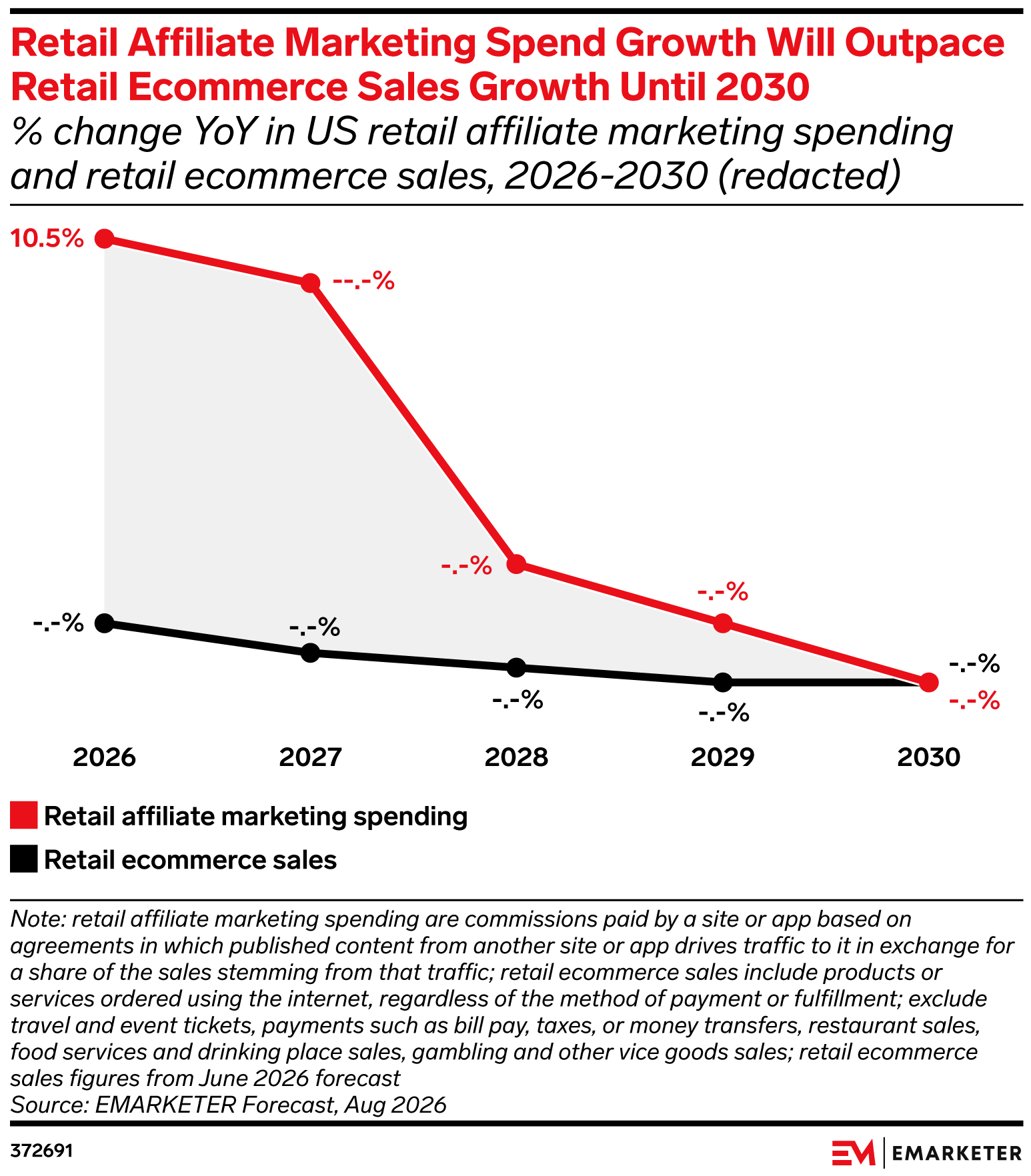
EMARKETER forecasts that US affiliate marketing spending will surpass $14 billion in 2026, growing 11.4% year over year. Retail affiliate marketing spend is forecast to rise 10.5% this year and to grow faster than US retail ecommerce sales through 2030.
That is a meaningful signal.
Brands are not merely expanding an old “affiliate channel.” They are spending more on the people, publishers, creators, communities, and commerce environments that shape decisions before a purchase is recorded.
Yes, it's becoming more “partner-like,” not just in name, but in reality.
EMARKETER names three drivers: creators, expanding retail ecommerce, and growing interest in affiliate publishers as a way to improve visibility in AI search. SaaS is also pushing this as its harder, it's more innovative, and partner marketing makes up a larger % of its business than in consumer.
CJU further validated these trends and laid out their view for partner marketing, leaning into the term connected commerce.
The old model was a silo: affiliate sat in performance marketing, creators sat in social, retail media sat with commerce, SEO sat with content, and AI search sat in a slide deck nobody fully owned.
What do they mean by connected commerce?
The Three Paths Are Real
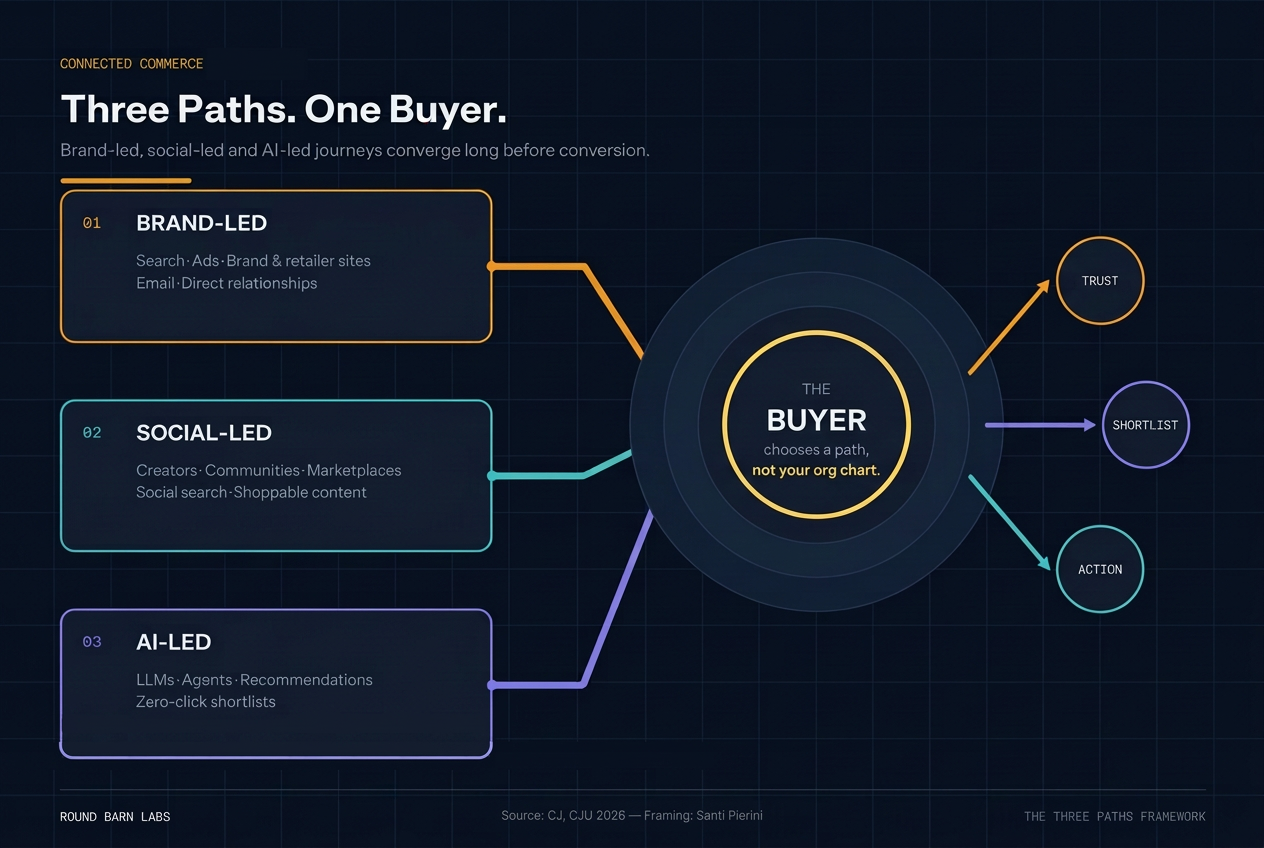
CJ CEO Santi Pierini opened CJU with a useful framing: buyers increasingly travel through three paths—brand-led, social-led, and AI-led—and most marketing organizations were built for one while improvising the other two.
- The brand-led path includes search, advertising, retailer and brand sites, email, and direct customer relationships.
- The social-led path includes creators, communities, marketplaces, social search, and shoppable content.
- The AI-led path includes LLMs, agents, AI recommendations, and the emerging zero-click environments that increasingly create the shopper’s shortlist before a traditional query or website visit.
Actual consumer journeys do not respect those organizational lines.
A consumer may see a creator’s video, validate the product through an AI assistant, check a publisher review, compare pricing on a marketplace, receive a retailer offer, and finally convert through an affiliate link or a direct visit.
Which team owns that journey? Most companies cannot answer cleanly today.
That is precisely why partner marketing is becoming more strategic. The right partner ecosystem can give a brand credibility, distribution, content, audience intelligence, conversion paths, and measurement signals across all three paths.
We live in a trust gap. Partner Marketing is your way out.
The connective ingredient is trust. (I wonder who keeps talking about trust? 😉)
Customers trust a creator differently than a brand ad. They trust a high-quality review publisher differently than an AI answer. They may trust a loyalty, coupon, comparison, or marketplace experience at the final moment of purchase or when they need a deal/cashback.
Winning doesn't mean appearing everywhere. It means being coherent, credible, and commercially prepared wherever the buyer chooses to validate the decision.
Creator Commerce Is Not A Side Channel
The most consequential change at CJU: creators.
Creator marketing is no longer being discussed as a separate awareness tactic that happens to sit adjacent to affiliate. It is becoming a commerce channel with distinct roles, commercial models, and measurement requirements.
The wrong question is: Should creators be paid on CPA?
The better question is: What job is each creator doing in the customer journey, and what commercial model makes that job sustainable?
Caveat: This is NOT unique to CJ. Impact has also been making big bets on Creator, AI, and retail commerce, so this is a strong validation of where our industry is heading.
A large creator may efficiently create broad awareness, cultural relevance, and a high-volume content moment.
A mid-tier creator may be ideal for a niche category explanation, a review, or a product launch. Nano and micro creators can often generate a level of authenticity and engagement that a celebrity partnership cannot—especially when product seeding creates many credible, differentiated pieces of content rather than one polished campaign asset.
That does not mean every creator should be paid only on a commission model. Nor does it mean brands should return to a world where creator fees are disconnected from business outcomes.
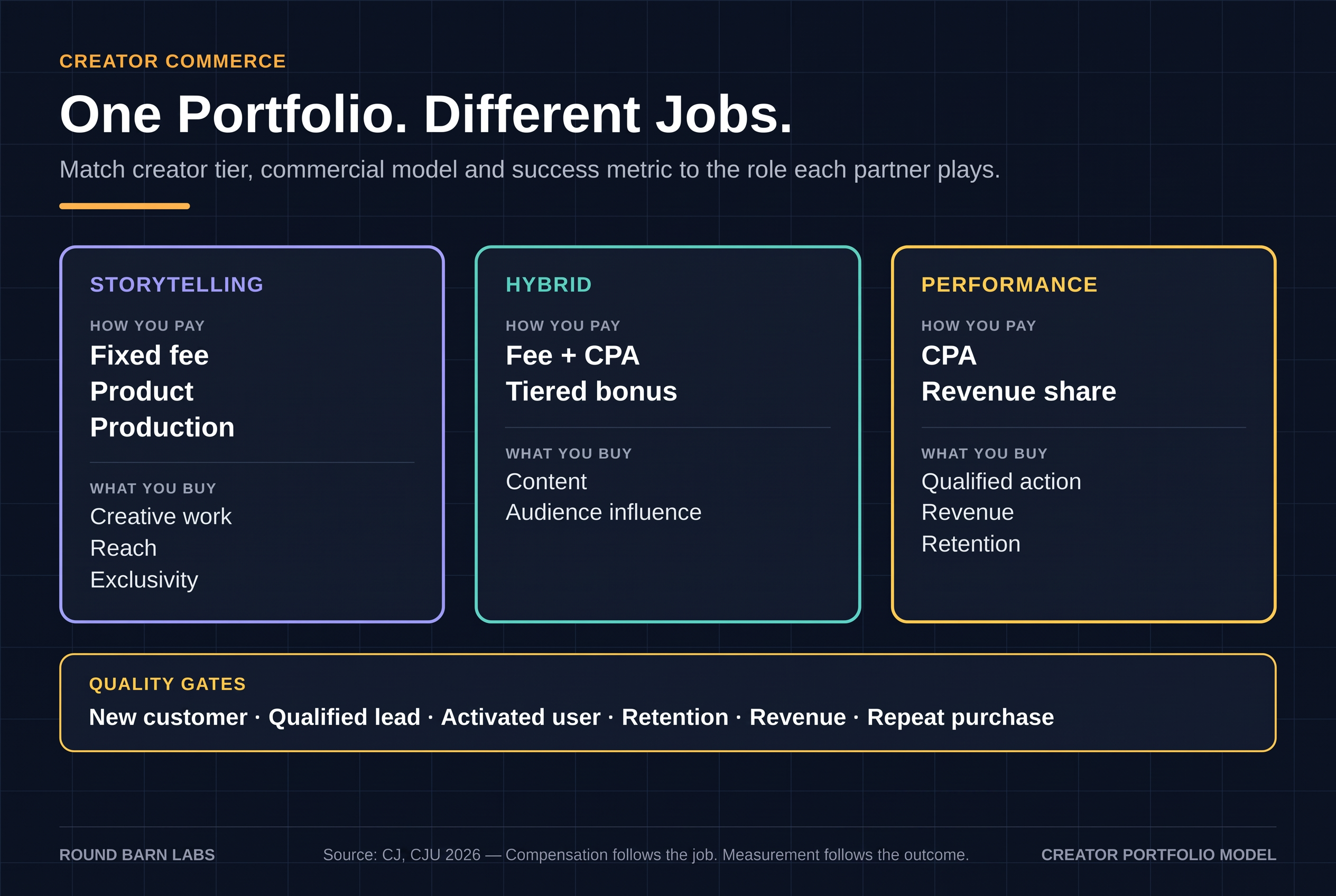
The durable answer is a portfolio model: (for those loyal readers of the RBL flywheel newsletter and our client QBRs, you have likely seen this analogy)
- Use fixed fees, product, or production support where the brand is buying creative work, reach, exclusivity, or guaranteed content.
- Yes, a creator can be an extension of your storytelling
- Yes, you need to think about ways to allow third-party creators to tell your story IN THEIR WORDS
- Use CPA, revenue share, hybrid incentives, or tiered bonuses where conversion is measurable and the creator has a practical role in driving it.
- Use quality gates for mature programs: new customers, qualified leads, activated users, retained customers, revenue, repeat purchase, or pipeline—not just top-line clicks and orders.
- Yes, networks are moving toward improving payout methods and the ability to pay out on nuanced outcomes in Creator
- Match creator tier to the task. Do not use a single compensation system for a celebrity launch, a product-seeding program, and a high-intent review partner.
This is the nuance that has often been missing from the “creator versus affiliate” debate. Creators can create demand well before the final click. But that doesn't make every creator responsible for every eventual sale, and it doesn't make last-click measurement useless.
Attribution and compensation overlap, but they are not identical. I talked about this with the Everflow team recently: how people confuse payouts, tracking, attribution, and incrementality
Last-click can remain a transparent payment rule for certain partners. It does not fully explain influence. A mature program recognizes that difference, then designs contracts and measurement accordingly.
The Measurement Problem Is Now A Growth Problem
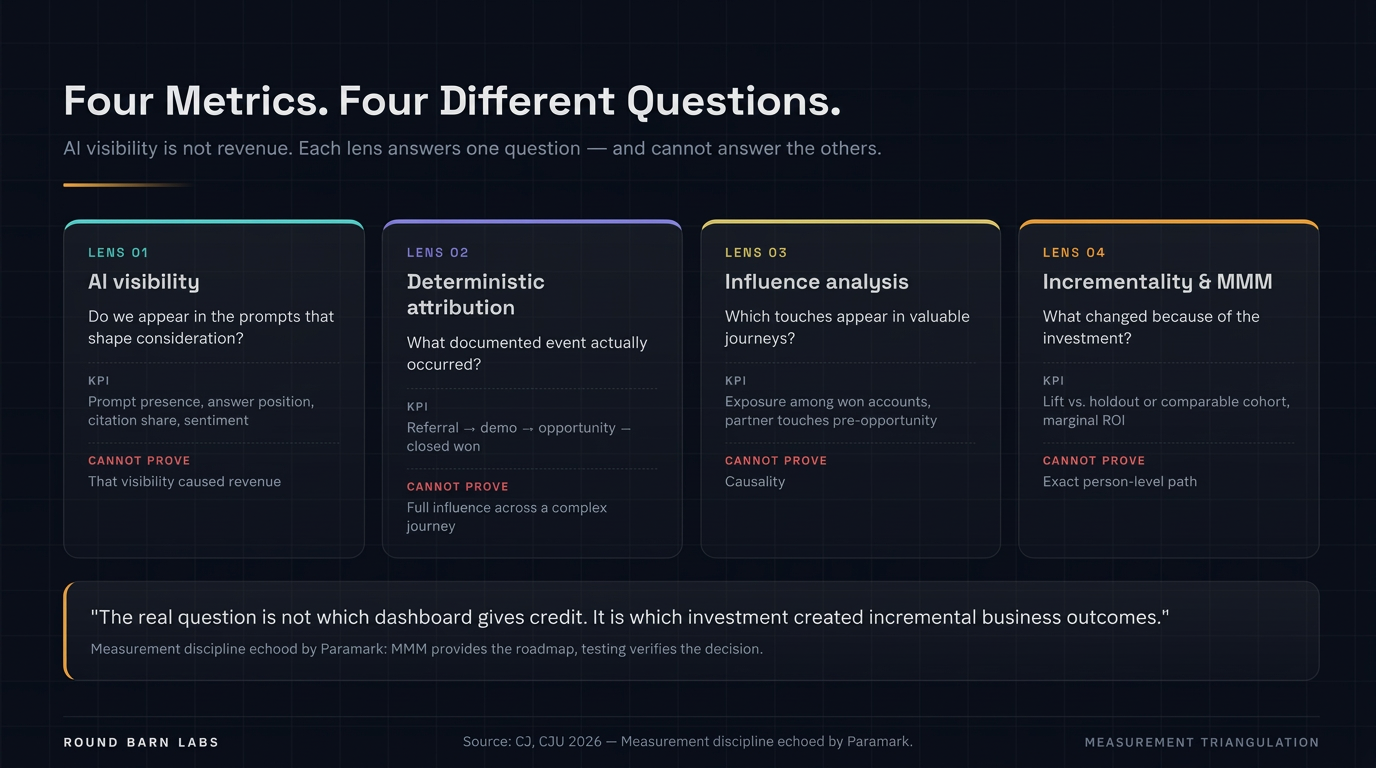
Affiliate marketing has a long history of arguing about credit.
CJU made clear that the bigger issue is increasing visibility.
Shout-out to my fellow Performance Marketing Association Measurement Council members. Traditional reporting captures what tracked cleanly. That is not necessarily what happened.
Consent requirements, browser restrictions, mobile and app complexity, pixel loss, CRM gaps, cross-device journeys, and incomplete integrations all create blind spots.
A partner may create value that never appears in a dashboard. Conversely, a tracked conversion may not represent the incremental value a partner created.
Both things can be true.
CJ’s large product and programmatic bet is to close more of that gap through diagnostics, reconciliation, complete integrations, and quantified estimates of performance that otherwise goes untracked.
The stated objective is not just cleaner reporting. It is to help advertisers budget, forecast, defend investment, and compensate publishers and creators using a more complete read of partner contribution.
That is directionally right.
The next generation of partner measurement needs to answer several questions at once:
- Did the partner create a measurable conversion?
- Did the partner influence a customer who later converted elsewhere?
- Was the customer new, qualified, activated, retained, or profitable?
- What would the customer have done if that partner had not been present?
- Did the partner drive the desired customer behavior at an efficient marginal cost?
CJU’s incrementality session with Capital One Ad Solutions pointed to a stronger framework: pair holdout testing with customer-journey analysis.
A holdout can show whether sales changed when a publisher disappeared. Journey analysis can help answer what happened next: did customers convert through another affiliate, convert direct, shift to paid media, or simply drop out of the journey?
That is the difference between asking, “Did the partner get credit?” and asking, “What value did the partner create?”
Walt and Capital One have always innovated on this, and they're a standout partner for a reason: they share a similar mindset to dare, I say it…
Always Be Testing 😉
AI Discovery Makes Publishers More Important, Not Less
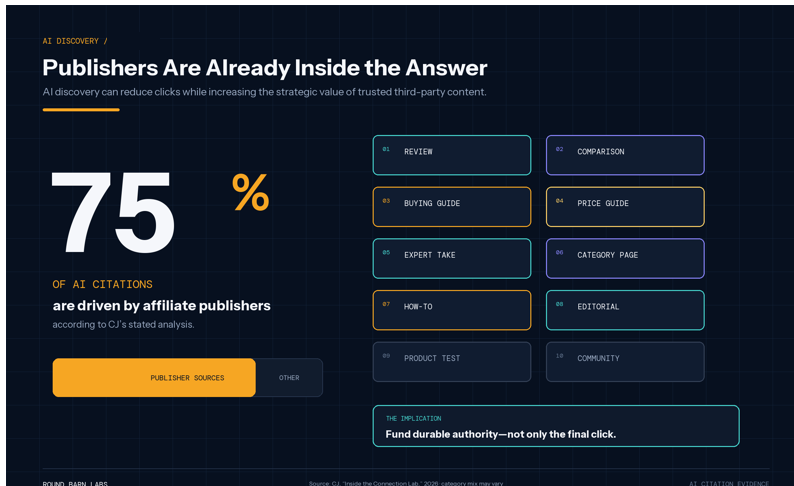
The AI conversation is frequently framed as a threat to publishers because of zero-click behavior. That risk is real. But the better CJU insight was that publishers can become more—not less—important if they are among the sources AI systems cite and rely upon.
CJ stated that affiliate publishers drive approximately 75% of product citations in AI environments. Higher than some of the Profound data recently shared and discussed. If that figure holds, it is a major strategic fact for brands and publishers alike: high-quality affiliate content is already a meaningful part of the evidence layer AI systems use to form product recommendations.
This creates a new assignment for publisher partnerships.
Brands need to think beyond traffic acquisition and ask:
- Which publishers are shaping category understanding in AI answers?
- Are our products, features, use cases, prices, and proof points represented accurately in those sources?
- Which reviews, comparisons, buying guides, and expert resources make our offering easier to understand and recommend?
- Are we funding the publishers that create durable decision-making content—or only the last-click properties that catch demand at checkout?
For publishers, the playbook is equally practical:
- Make content technically accessible to AI systems where appropriate.
- Build pages with clear structure, direct answers, comparison logic, accurate product data, original expertise, and regularly maintained information.
- Build topical authority rather than publishing thin, interchangeable affiliate pages.
- Treat citations, mentions, AI referral traffic, and content inclusion as emerging commercial signals—not vanity metrics.
- Create advertiser offerings around authority and influence, not only pageviews and last-click revenue.
Yes, we have built out reporting for clients to illustrate the GEO visibility score to showcase how they are showing up in AI Answers versus their competition on various prompts for citations, ranking, and sentiment.
Get Your AI Visibility ScoreAI discovery will not eliminate the need for trusted third parties. It may increase their premium. LLMs need sources. Consumers need verification. Brands need credible explanations that do more than repeat product copy.
I spoke yesterday with one of the most successful paid marketing agency leaders in the space about how brands need a way to make sense of all the noise, buzzwords, FOMO, and AI services and tools. It’s exciting to be able to help clarify that for advertisers.
Connected Identity Is The Data Bet
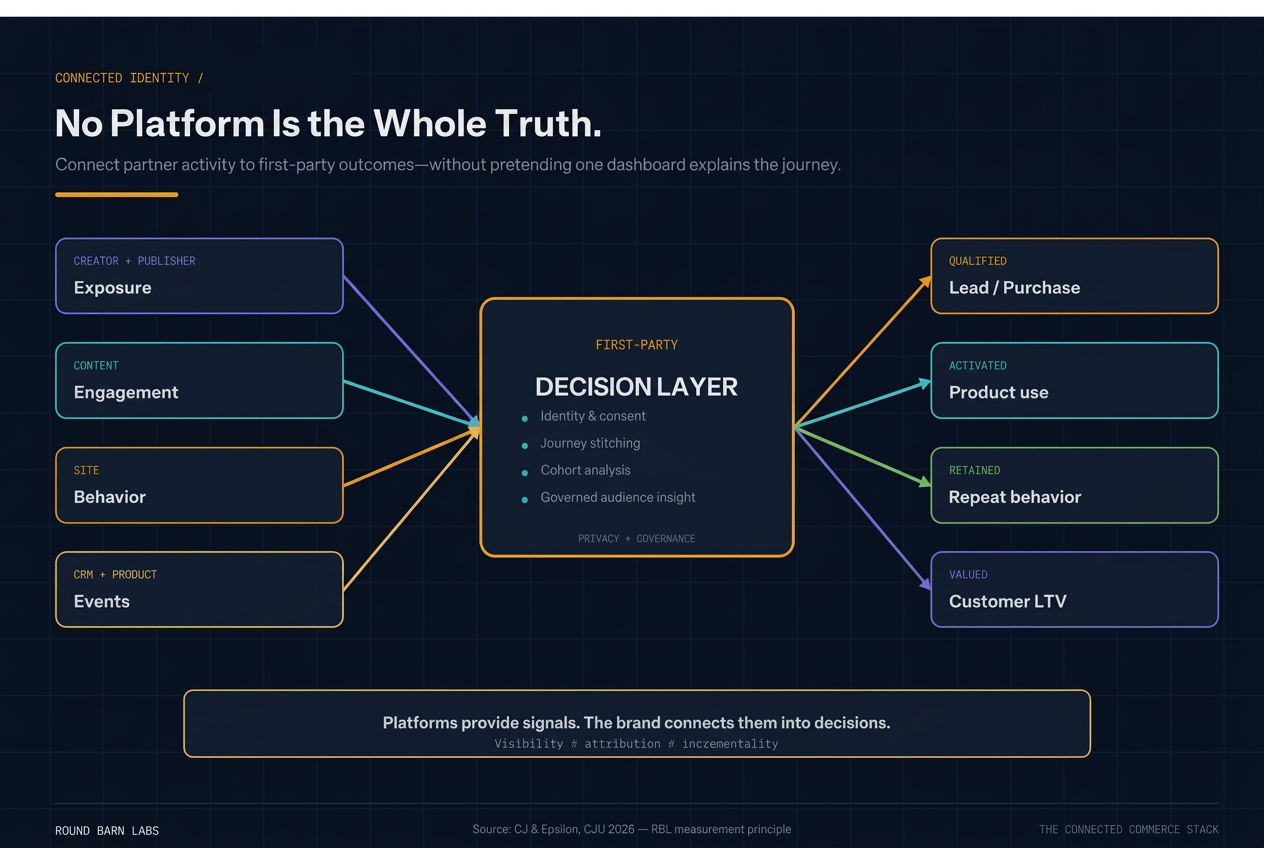
CJ and Epsilon also put a major stake in connected identity: using privacy-first identity capabilities to turn commerce signals into shopper intelligence, broader reach, stronger engagement, and new monetization opportunities for advertisers, publishers, and creators.
In practical terms, this is the direction the industry has to go.
The affiliate network cannot be the only source of truth. Neither can a creator platform, an ad platform, a retail media network, or a web analytics package. Brands need a way to connect partner activity to first-party customer outcomes while preserving privacy and respecting each partner's actual role.
The future stack will connect:
- Creator and publisher exposure
- Clicks and content engagement
- Onsite behavior
- CRM and product events
- Qualified leads or purchases
- Activation and retention
- Customer value over time
- Audience-level insight where permission and governance allow
This is not a call for perfect attribution. Perfect attribution does not exist.
It is a call for better operating decisions.
If a creator partnership drives lower immediate conversion but produces a cohort with stronger activation and retention, that matters. If a publisher appears in AI citations and later shows more branded search, direct traffic, and higher-quality conversions, that matters. If a loyalty partner takes the final click but does not change the likelihood of purchase, that matters too.
We need to stop asking one report to settle every question.
Affiliate Spend Is Growing Because The Role Is Expanding
The EMARKETER forecast shows affiliate spend growing faster than retail ecommerce sales through 2030.
That does not mean every affiliate program will grow automatically. If you have read my writing in the past, you know all too well - IT REQUIRES ACTIVE MANAGEMENT!
It means the market increasingly values performance partnerships as commerce becomes harder to navigate. Of course, I have written about this at length for years.
Three forces are driving that expansion:
1. Creators are becoming measurable commerce infrastructure
Creators have become discovery engines, trusted explainers, community builders, and increasingly direct sellers. Social platforms are closing the distance from content to checkout, while affiliate mechanics let brands connect creator activity to commercial outcomes.
2. Retail ecommerce keeps creating more surfaces to buy
Retail media, marketplaces, social commerce, publisher commerce, brand sites, loyalty platforms, and AI interfaces are multiplying places where customers discover and convert. Affiliate and partner programs can connect those surfaces—if the program is designed as a portfolio rather than a list of links.
3. AI search is making third-party authority more valuable
As more discovery occurs through AI answers and agents, brands need credible third-party sources that explain, compare, validate, and recommend their products. Publishers and creators may become even more important to the discovery layer, particularly when they produce original, structured, useful content.
The growth forecast is therefore not merely a media-spend story. It signals that affiliate is becoming a mechanism for buying trust, distribution, audience access, content, and measurable commercial outcomes across a more fragmented journey.
What Brands Should Do Now
The companies that benefit most from this shift will not treat partnership marketing as a separate channel or a collection of applications to approve.
They will build a partner operating system.
1. Segment partners by the job they do
Do not group creators, editorial publishers, review sites, loyalty partners, coupon partners, strategic technology partners, marketplaces, and paid media partners into one undifferentiated “affiliate” category.
Define whether each partner is primarily responsible for:
- Demand creation
- Education and consideration
- Product discovery
- Conversion capture
- Distribution
- Retention and advocacy
- Audience access
- Data and insight
This is an approach we've used with brands like Meta Quest, TikTok, Atlassian, Superhuman, and SC Johnson.
Get Your AuditThen set the right commercial model, KPI, and measurement expectation for that role.
2. Build creator programs as portfolios
Use a mix of creators across tiers and purposes. Test seeding, affiliate activation, recurring ambassadors, paid campaigns, and hybrid models. Build creator briefs around audience value and business objectives—not just talking points and posting dates.
Most importantly, do not force a single payment model on every creator. Pay for what you are buying, then measure what you can improve.
3. Fix tracking before declaring a partner underperforming
Audit server-side tracking, CRM integration, mobile and app capture, consent impacts, reversal logic, link quality, cross-channel deduplication, and data reconciliation.
The cheapest growth opportunity in many partner programs is discovering value already being created but never recognized.
4. Treat publishers as AI discovery partners
Map the publishers that influence category research and AI visibility. Invest in useful, accurate, expert content. Ensure partners have current product information, compelling use cases, trustworthy proof, and clear commercial terms.
Do not confuse buying a backlink with building authority. The latter requires durable relationships, quality content, and real user value.
5. Make incrementality a habit, not an annual project
Use holdouts, geo experiments, audience splits, cohort analysis, and journey data where possible. Ask what changed when a partner was present—and what customers did when that partner was absent.
Some partners will prove more incremental than their last-click contribution suggests. Others will prove less. Both findings are useful.
6. Put internal data at the center
In a multi-network, multi-platform, creator-and-publisher world, no external platform can be the full system of record.
The brand’s own first-party data and BI layer need to reconcile the view. That does not diminish networks or platforms. It lets them perform their real job: providing infrastructure, reach, workflow, measurement, quality controls, and partner access—while the brand retains the ability to make an informed commercial decision.
The Bigger Point
CJU 2026 did not present a future where affiliate disappears into creator, retail media, or AI.
It presented a future where affiliate becomes the commercial and measurement layer that connects them.
That is a much bigger opportunity—and a much higher bar.
The teams that win will connect creator storytelling to conversion, publisher authority to AI discovery, partner exposure to customer value, and commerce data to smarter investment decisions.
They will be clear about what they are paying for. They will make tracking more resilient. They will reward genuine contribution. They will use experimentation to challenge their assumptions. And they will recognize that trust is not a brand value floating above the work—it is an operating system built through transparent rules, clean data, credible partners, and better customer experiences.
Affiliate marketing is growing faster than ecommerce because it is becoming more than affiliate marketing.
It is becoming connected commerce.
Get Your Partner Program Audit