Escaping the “7% Trap”: The Operational Architecture of a 25% SaaS Partner Engine
In our recent episode of SaaS Class, I sat down with Nancy Harnett (Instantly.ai) and Guy Yalif (Webflow) to tackle the “7% Trap”—the ceiling where most B2B SaaS partner programs plateau before they can mature into massive revenue engines.
The conversation was phenomenal, but it left me thinking deeply about the underlying mechanics we discussed.
I wanted to double-click on our dialogue and expand it into a definitive blueprint. This isn't just a summary of what the three of us talked about; it is an expansion of those concepts into a strict, operational progression.
Getting a partner program from 7% to a mandated 25% of company revenue requires crossing a chasm. You have to abandon the B2C “spray and pray” mindset and build a deeply integrated extension of your sales architecture.
Here is my expanded, step-by-step progression of what it actually takes to get there—moving from non-negotiable foundations up to advanced AI attribution and long-term activation.
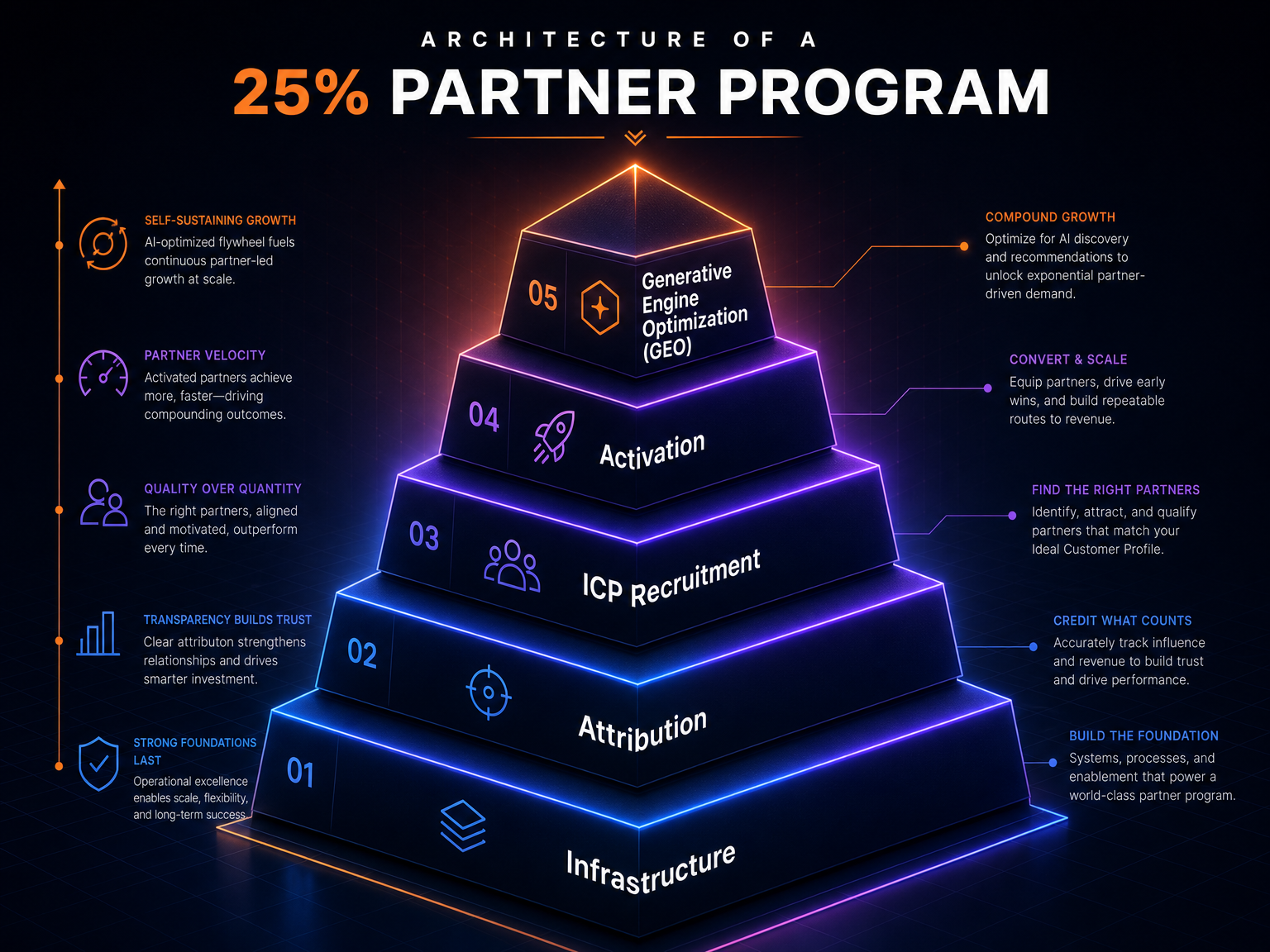
Phase 1: The Non-Negotiable Foundation (Infrastructure & Buy-in)
Before recruiting a single partner, the plumbing must be flawless. If you cannot prove closed-won revenue, you will lose your budget. Period. As we say far too often, you cannot pour water into a leaky bucket.
1. Secure Executive Buy-in: Without a mandate from the C-suite, your program will die at the first sign of channel conflict. You need explicit alignment on how partner revenue will be tracked, valued, and compensated alongside direct sales.
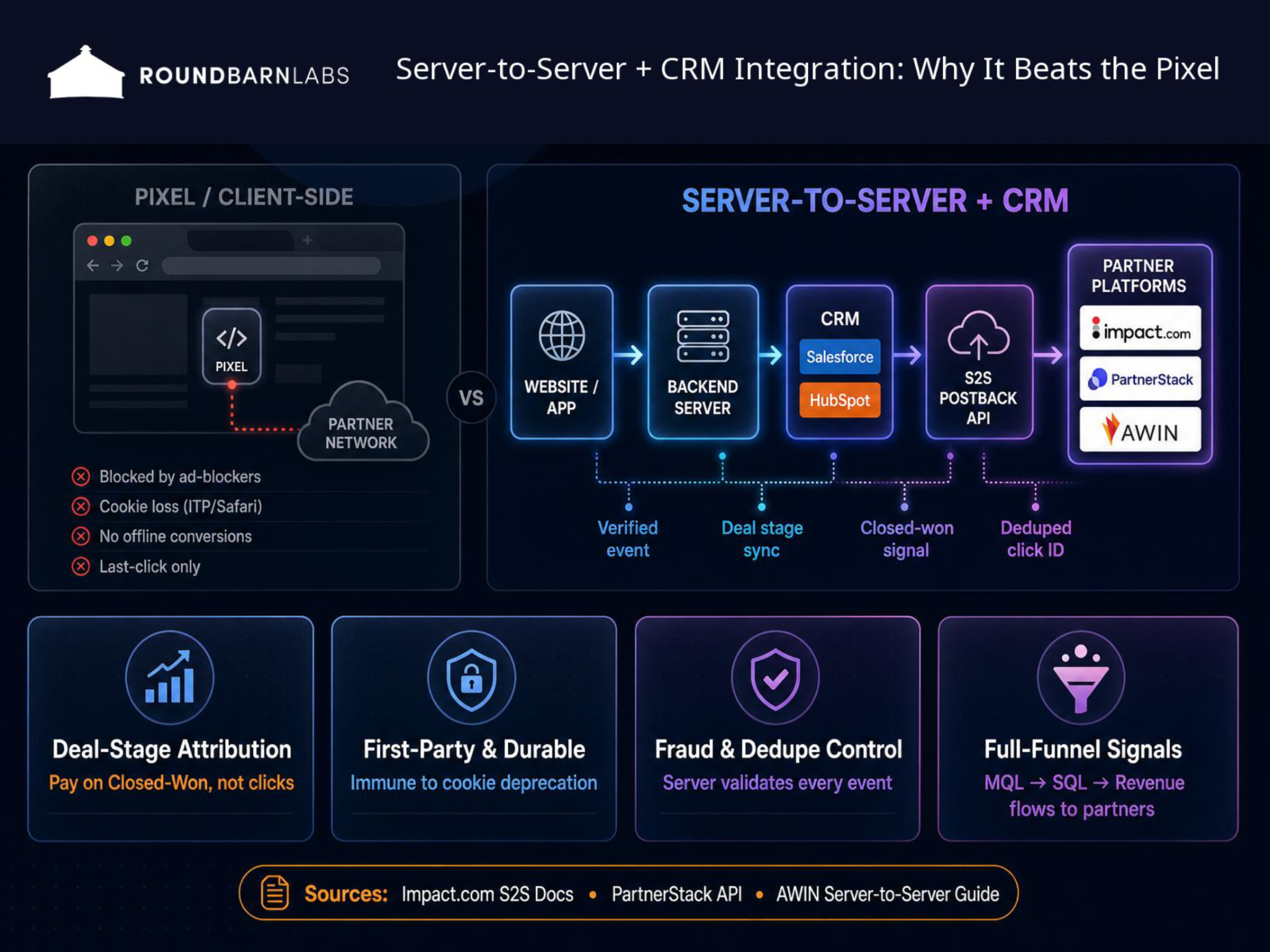
2. Implement Server-to-Server + CRM Integration: Basic pixel tracking is dead. Establish a robust technical foundation and a system for audit reviews and continuous improvement. This includes strict fraud checks and audits, so you are only paying for a legitimate pipeline. Why dead? Privacy regulations like GDPR, aggressive ad blockers, complex cross-device buyer journeys, and declined-consent banners cause programs to silently lose 14-20% of their accurately tracked affiliate revenue.
3. Align Payouts with Target Economics: Build a competitive payout system strictly aligned with your internal LTV:CAC targets. Pair this with clear, documented policies (search, content, promotion), so partners have absolutely no doubt what is allowed and what is not.
Most programs are built as acquisition channels and nothing else. Partner brings a lead, partner gets a commission, cycle repeats. That's fine at 7%. It doesn't get you to 25%. The shift is making partnerships felt across the whole business. Product is hearing what partners are seeing in the market. Customer success knows which customers came through the partner channel and why that matters for retention. Marketing is building with partners, not just alongside them. When partnerships is siloed into its own lane, you cap out. When it feeds the rest of the org, it compounds.
Phase 2: The Modern Attribution Engine
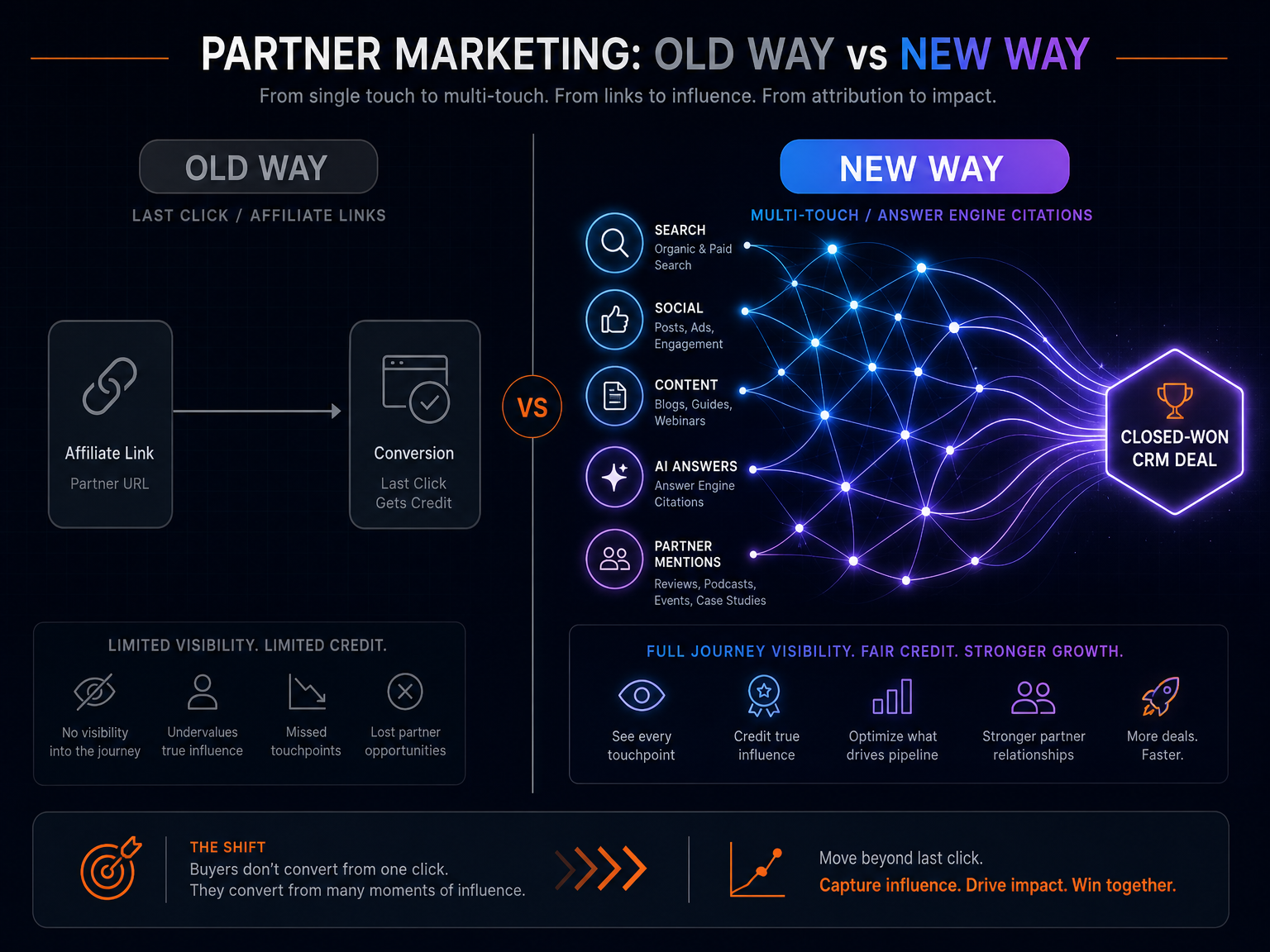
If you only reward the entity that captured the final click, you will starve the partners who actually educated the buyer.
We have been living through this for years, and we have been counseling brands to rethink it using a mix of technology, attribution, and commission rules.
4. Deploy Thoughtful Multi-Touch Attribution: Compare your network data against your in-house analytics. You must be able to prove a partner's value when they influence a deal early, even if they don't capture the final conversion. While you ideally want your network to track accurately, comparing it to your in-house data enables an honest assessment and helps keep all parties honest, improving accuracy.
This is where most programs are flying blind. Which partners are driving high-LTV customers versus high-volume, low-retention ones? Which content is influencing deals early, even when it doesn't capture the last click? Where are you showing up in AI-generated answers, and where are competitors beating you? That data should be shaping who you recruit, how you tier, and where you put creative resources. Intuition gets you started. Data is what scales it.
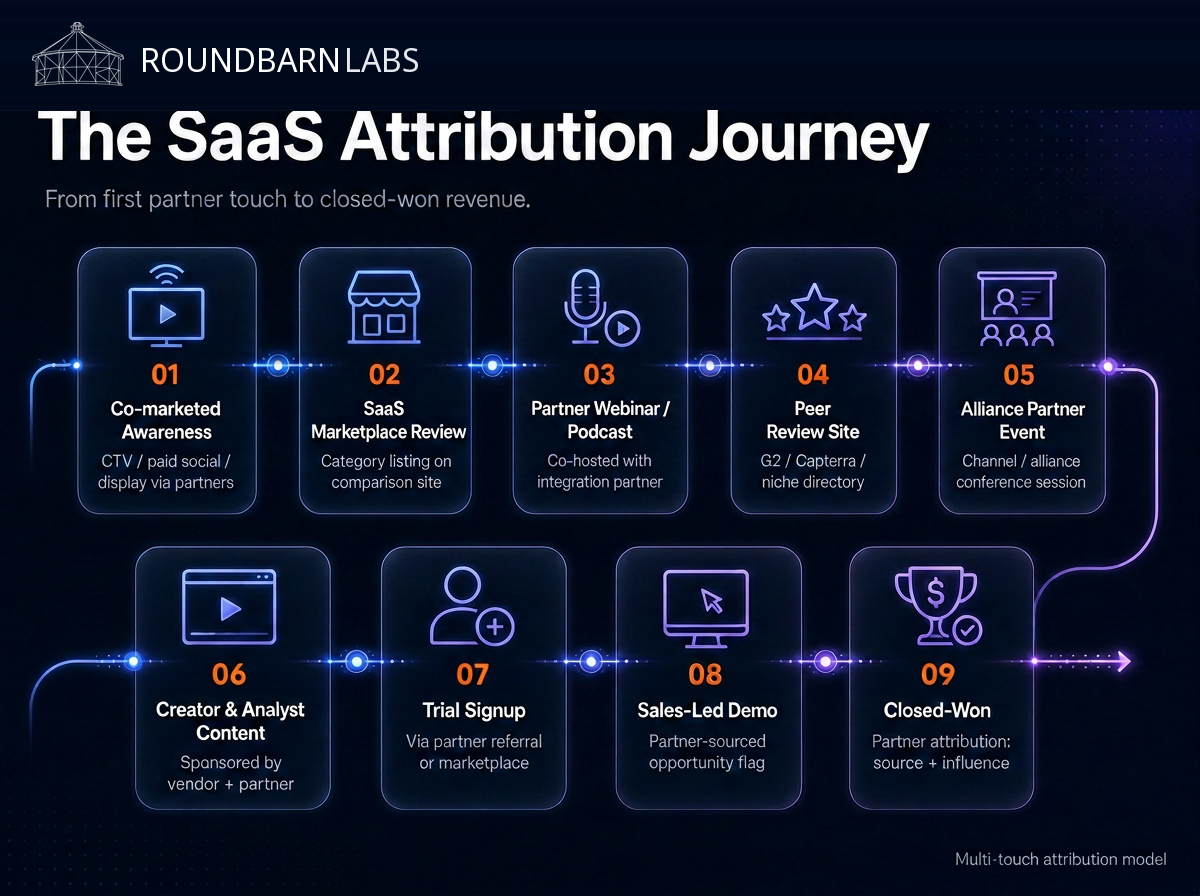
5. Track GEO (Generative Engine Optimization) Visibility: Search is shifting dramatically toward AI answer engines like ChatGPT, Perplexity, and Google's AI Overviews. Modern partner marketing is about driving top- and bottom-funnel AI impact. Track GEO visibility based on partner citations, rankings, competitors, and sentiment.
Search is shifting as B2B buyers move from keyword search to AI answer engines like ChatGPT, Perplexity, and Gemini. Visibility is no longer just about blue links; it's about whether your brand shows up in the answers when AI is doing the research for your buyers. In that world, brand is back at the center because LLMs learn from what you say consistently, how others reference you, and how clearly your content answers real buyer questions across the funnel.
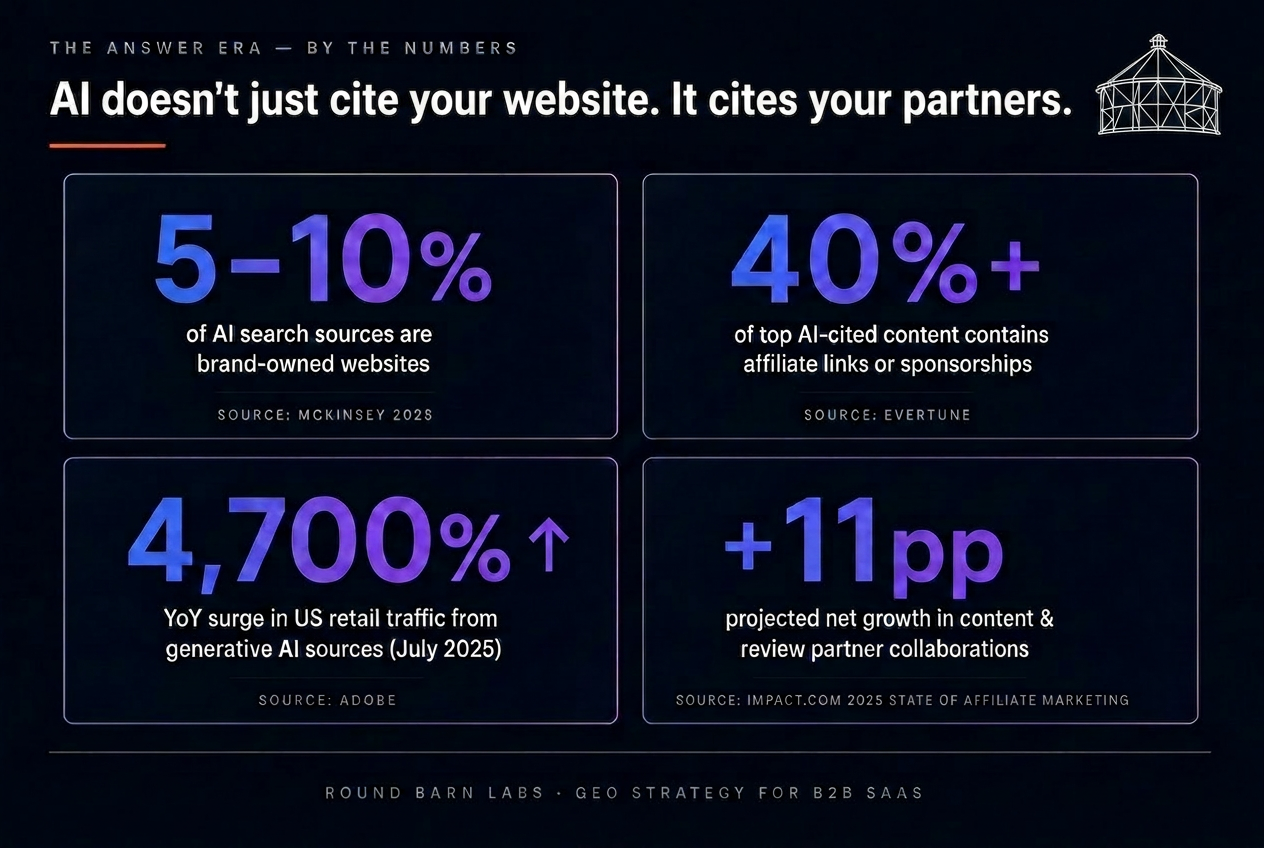
If you are not thinking about BRAND AND GEO in your Partner Marketing efforts, you are not going to get to meet the 25% of revenue challenge. My last write-up on the topic of GEO for those that want to go deeper → The AI Trust Gap: Why GEO Success Requires Partner Marketing.
Phase 3: ICP-Led Recruitment
Always Be Recruiting, but completely abandon the volume-based mindset. You want 10 deeply integrated partners, not 1,000 mediocre affiliates—Nancy and I really doubled down on this topic on the pod. The ideal state is volume and quality, and the best partner marketing teams in the world achieve this.
Truly knowing a brand's Ideal Customer Personas, segments, pain points, and associated product value propositions is critical to any constructive recruitment effort.
Our proprietary matchmaking algorithm, TruPartner Score™, uses AI and our >25k partner database to ensure audience match and authentic trust. This enables quality and quantity, not one or the other.
Relationships (Networks and Partners) + Experience + TruPartner Score™ + AI outbound
6. Tie Recruitment Directly to Your ICP: Take a strict Ideal Customer Profile (ICP) based approach. Have a clear understanding of the partner's audience. You are looking for a story about the match and why it fundamentally makes sense for their specific community.
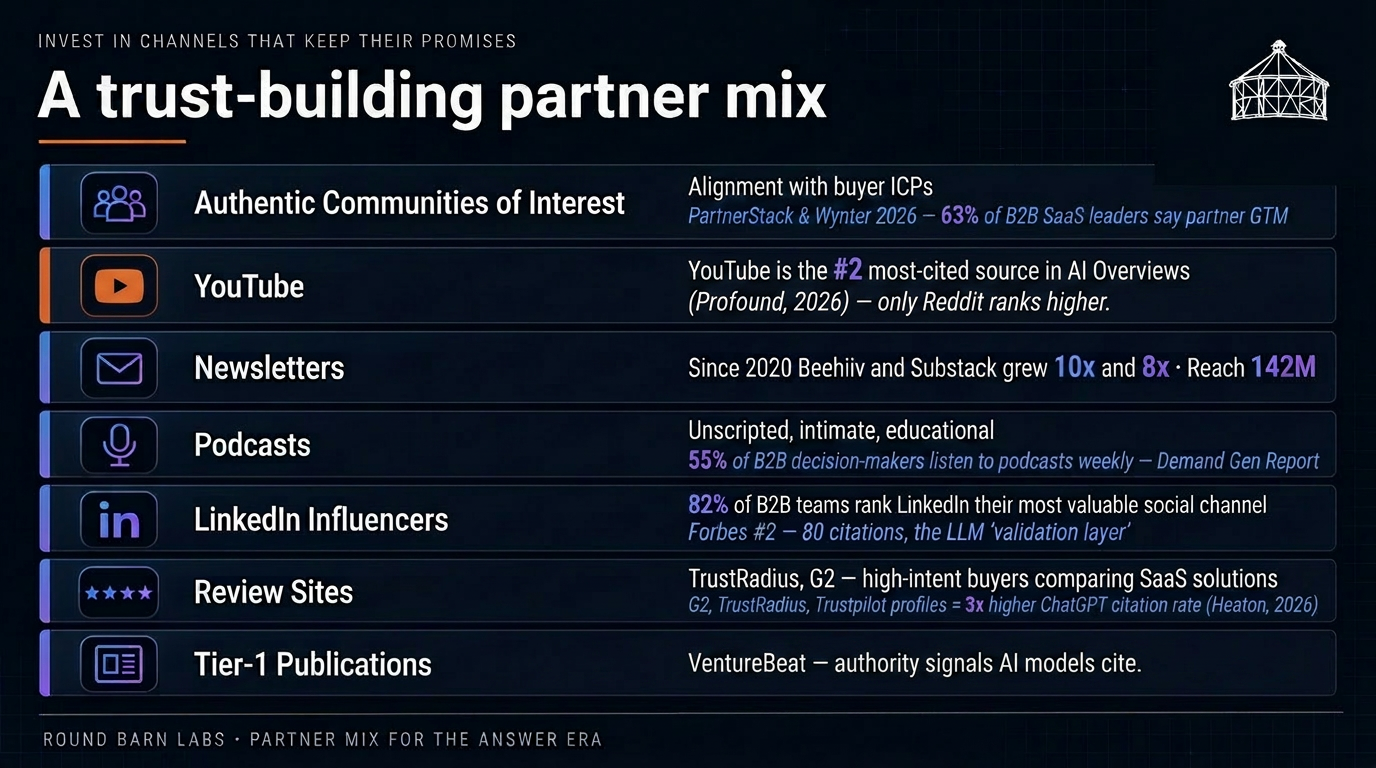
7. Expand the Sandbox Beyond Traditional Networks: This approach leads you to communities of interest far outside traditional top partners, unlocking Affiliates, Creators, Value-Added Resellers (VARs)/Agencies, and deep Technology Integrations. You must activate creative arenas like:
- YouTube: Authoritative voices, customers, buyers
- LinkedIn & Reddit: Professional networks and authentic peer discussions
- Performance PR: Editorial publications relevant to your industry (e.g., Entrepreneur, CIO.com)
- Reviews & Listicles: G2, Technology Advice
- Audio & Video: Connected TV and Podcasts
- Newsletters: Substack and Beehiiv niche email newsletters
Bonus tip
When someone says, ‘I’ll get you to 25%,’ I’m excited—but first I want to know: is the 7% we have today durable, repeatable, and not cherry‑picked, and how concentrated is it? Just like an investor, I’m looking at partner revenue concentration and risk before I sign off on that jump.
Guy makes a great point here that raises a number of factors required to go from the pedestrian 7% of revenue to the illustrious hallowed ground of 25%.
- Diversification (partner types, partners, traffic sources)
- Mitigate concentration risk. Aim for:
- Top 10 partners ≤ 60% of partner revenue.
- No single partner > 20% of partner revenue.
- At least 3 partner archetypes contributing ≥10% each (e.g., content/publication, review, technology integration, value-added reseller).
- Quality traffic and actions - tie quality metric to lead, download, and MQL to ensure the performance is higher quality and sustainable
We touch on a number of other pieces of advice that help you go from 7% to 25% while also ensuring that the path to 25% is real, not just fool’s gold!
Phase 4: Deep Activation & The Long Game
As we discussed on the show, recruitment is vanity; activation is sanity. If you don't enable your partners, they will churn in 60 days.
8. Be Pro Partner: Partners are often only as good as the brands and agencies that support them. Even the best partner can flounder if they are not given the ability to thrive or viewed as a trusted collaborator. Yes, this takes time, performance, and trust-building like any working relationship.
Think of them like an employee or member of your sales team—someone who can really drive business value.
The programs that break through 7% are the ones where the partner genuinely feels like they're part of something. They know the product roadmap. They get early access. Someone picks up the phone when something isn't working. They're in the loop the same way a good sales hire would be.
And it goes both ways. You have to know their business too. Their audience, their content style, what a good month looks like for them, what they care about beyond the commission. If you don't know that, you're not managing a partner, you're managing a link.
The internal side of this is just as important. Your sales team has to believe in the channel. If a partner-sourced lead lands and it gets deprioritised because a direct rep doesn't want to split credit, the partner finds out. Maybe not immediately, but they find out. And then you've lost them.
So when I say extension of the sales team, I mean structurally and culturally. Structurally: clear rules of engagement, protected commission, a seat at the table in terms of enablement and product access. Culturally: the business has to actually want partners to win. That starts at the top. If the CEO doesn't believe in the channel, no amount of tooling or recruitment fixes it.
9. Build a System of Regular Follow-up: Get out of email. Use modern tooling to find partners and meet them where they live and work. LinkedIn, conferences, pick up the phone—all of it matters. Too many practitioners neglect follow-up, activation (turning joined partners into traffic, leads, and revenue), and optimization (continuous improvement and growth for active partners).
10. Empower the Partner's Authentic Voice: Provide assets and guidelines that enable partners to use their own voice. Build a system of regular content creation to aid and improve their ability to promote your program. Align this with your internal marketing initiatives, but let them share the best of your product in their own words. This is particularly important for creators and influencers educating their audience in a “real,” trusted way—it will perform so much better with distrusting buyers than something that comes off as corporate or disingenuous.
11. Structure Multi-Lever Incentives: Deploy a mix of short-term bonuses and long-term rewards to activate dormant partners and maintain momentum. When partners evaluate brands to promote, they weigh overall ROI and many variables:
- Onboarding experience and friction (Nancy emphasized this)
- Commission rate
- Flat fee
- Cost-per-click options
- Bonus opportunities
- Landing page and corresponding conversion rate
- Media and content shared based on mutual feedback and data
- Brand guidelines
- Ideal Customer Persona info and other helpful learnings partners can use to their advantage
- Quality feedback and data loop—what’s in-platform only tells half the story. Give partners as close to real-time feedback as possible on data and action quality (e.g., are MQLs turning into SQLs and revenue? Are demos turning into purchases? Are users churning at a higher rate than via other channels?). All of this makes for more valuable, effective partnerships.
12. Execute Long-Term Creative Campaigns: The beauty of B2B SaaS is that you can afford to think long-term. Approach partners with this mindset, enabling influencers to build creative campaigns (like we did with Atlassian's Confluence and Alvin the PM).
This is where brand, performance, and long-term value converge to deliver better results.
A strong, long-term relationship allows you to lean in and avoid paying standard rack rates, securing better value for each of your placements. Yes, securing placements and the best rates with partners, publications, reviews, and creators is still very human.
13. Always Be Testing: Set aside a specific percentage of your partner budget for tests with documented hypotheses and rankings. The market is shifting too fast to rely on last year’s playbook. Of course, this has come up in multiple episodes of the Always Be Testing podcast.
If your dashboard shows you drove only 5% of revenue this quarter, your first lever tomorrow morning isn't finding 100 new affiliates. It is auditing this exact progression.
14. Humans for the win: AI and automation are becoming massive levers in SaaS growth and partner marketing. But when some of the most technically savvy SaaS growth and partner leaders lean in on experience instead of just tooling, it’s a useful reminder: the human side of this business isn’t going anywhere.
The programs that win will use AI to clear the noise so humans can spend more time on what machines can’t do: building trust, reading nuance, and making strategic bets with partners and brands. Knowing your partners deeply, understanding your customers, and exercising real judgment across the ecosystem is still the lifeblood of great partner marketing—and the differentiator AI can’t copy.
In the AI era, the highest-ROI “feature” in any partner program is still a human who knows the partners, knows the brand, and is trusted on both sides.
For the full conversation that inspired this framework, check out episode 2 of SaaS Class with Tye DeGrange, Nancy Harnett, and Guy Yalif.
Until next time!
Ready to escape the 7% Trap? Get your partner program audit →