The CMO's AI Discovery Measurement Problem: What to Fund When the Click Disappears
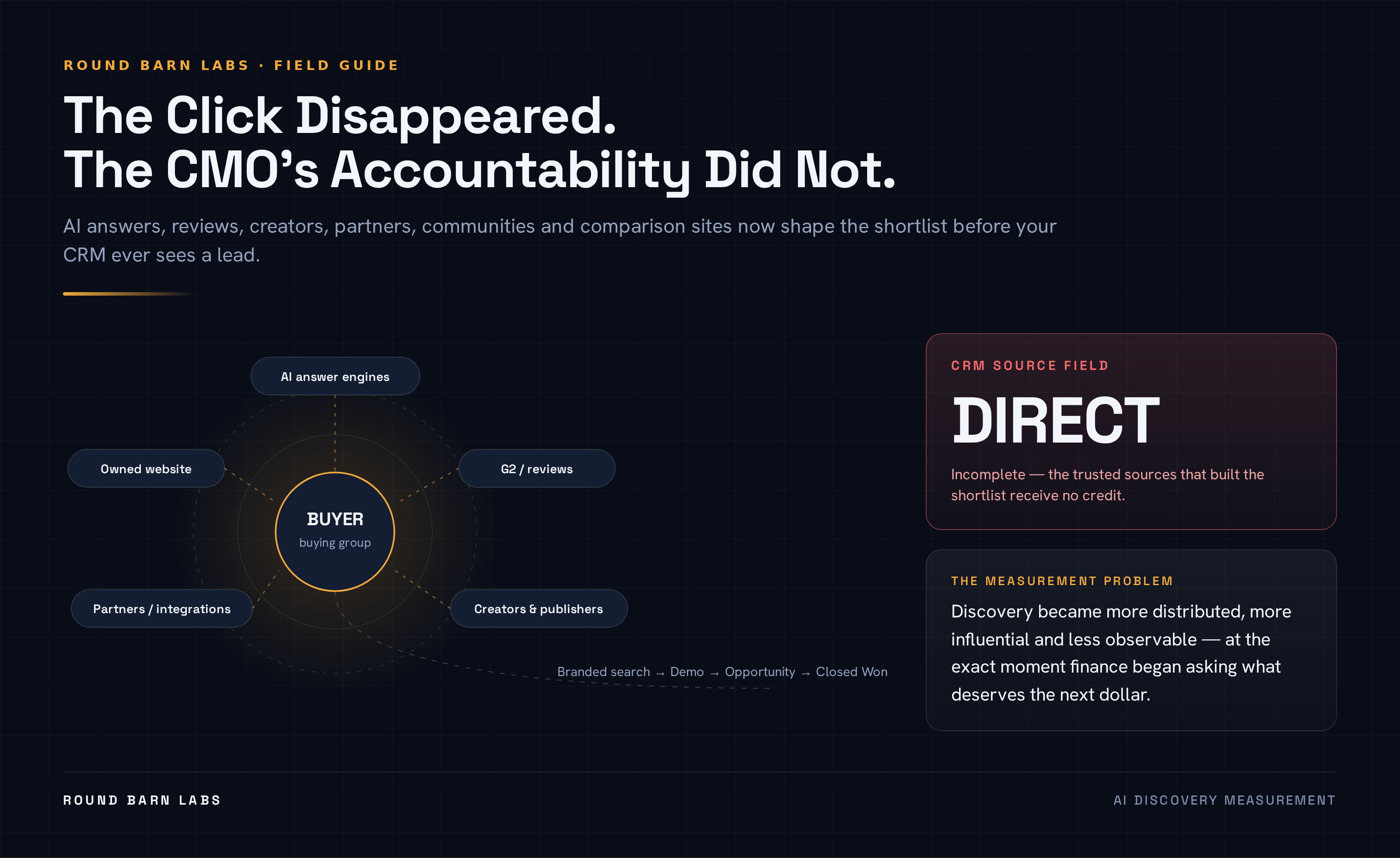
When buyers trust AI, peers, reviews, and partners before they ever click your site, what should a SaaS leader fund—and how do you prove it is creating pipeline rather than just visibility?
In AI-mediated B2B buying, the CMO's job is no longer only to create demand and capture it. It is to build — and prove — the company's presence across the sources AI systems and buying committees trust: reviews, comparison sites, credible publishers, partner content, customer evidence, communities, and first-party expertise.
What this means for the CMO: operate discovery as a portfolio of owned clarity, third-party authority, partner distribution, demand capture, and revenue proof. Measure each layer for the question it can actually answer.
AI is changing how buyers discover and validate SaaS vendors. The harder question is not whether your brand appears in an answer. It is how to understand which trusted sources created visibility and shortlist confidence — and which investments improved commercial outcomes when the journey left few trackable clicks.
- 82% of buyers in G2’s 2026 research said they sourced a software recommendation from an AI chatbot in the prior 24 months.
- 38% named review sites as a leading shortlist source, compared with 37% for AI chatbots.
- 80% of G2 product profiles reportedly receive more AI citations than human pageviews.
When a buyer asks, “What is the best HRIS for a global team?” or “Which CMS is best for a SaaS marketing team?”, the response may synthesize your product pages, review platforms, Reddit threads, creator videos, implementation partners, customer evidence, technical documentation, and third-party editorial coverage.
That buyer may then arrive through branded search, a direct visit, a demo request, a peer referral, or a sales-assisted path. The source that made the brand credible may never receive a click, cookie, or affiliate credit.
AI discovery is not primarily an SEO problem. It is an ecosystem-measurement problem.
1. The dashboard is increasingly blind
A buyer asks ChatGPT, Perplexity, Gemini, or Google AI Mode for the strongest tools in your category. Your company appears because a review platform corroborates your claims, an operator explains your implementation on YouTube, a technology partner documents the integration, and your own content makes the product legible.
Three days later, the buyer searches your name, books a demo, and becomes an opportunity. Your CRM records “branded organic.” Last-touch reporting says “direct.” The most valuable sources of confidence receive no credit.
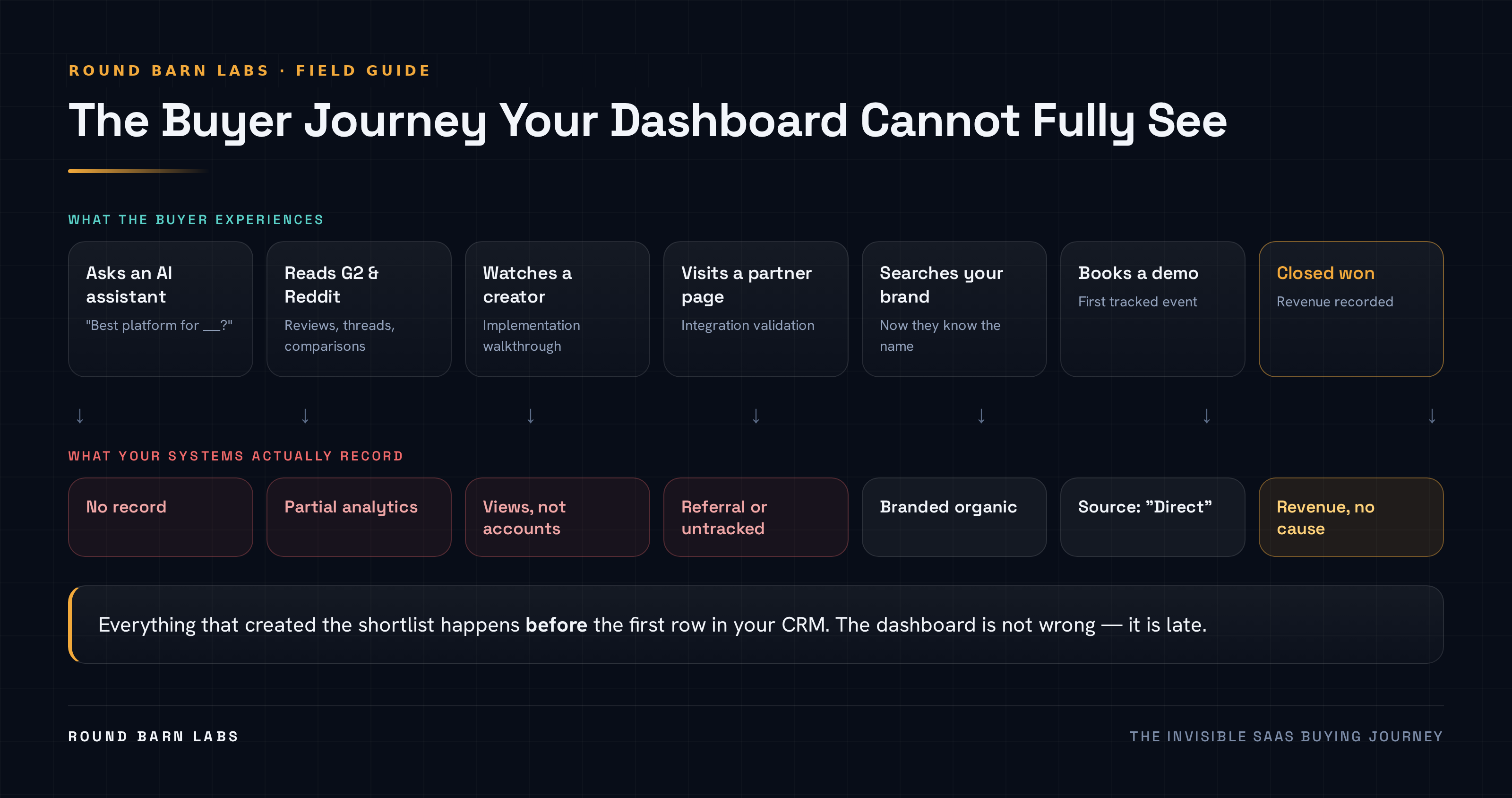
This is not simply a visibility problem. It is a budget-allocation problem. If the dashboard over-rewards capture and under-observes trust formation, leadership can easily defund the sources that made demand possible.
The key distinction: observable does not mean causal, and invisible does not mean unimportant. A known click can be recorded without being the reason a buyer chose you. An untracked review, partner recommendation, or AI answer can matter without producing a person-level trail. The measurement system has to accommodate both truths.
2. The funnel did not disappear. It became a trust graph.
The classic funnel remains useful for operating conversion. Paid and organic traffic still lead to landing pages, forms, qualified opportunities, and revenue. But it is no longer a complete description of how confidence forms.
Today's buyer triangulates. AI answers, reviews, creators, communities, integration partners, peer validation, and owned content combine into shortlist confidence. Multiple members of the buying group interact with different sources before a demo or sales conversation appears in the system.
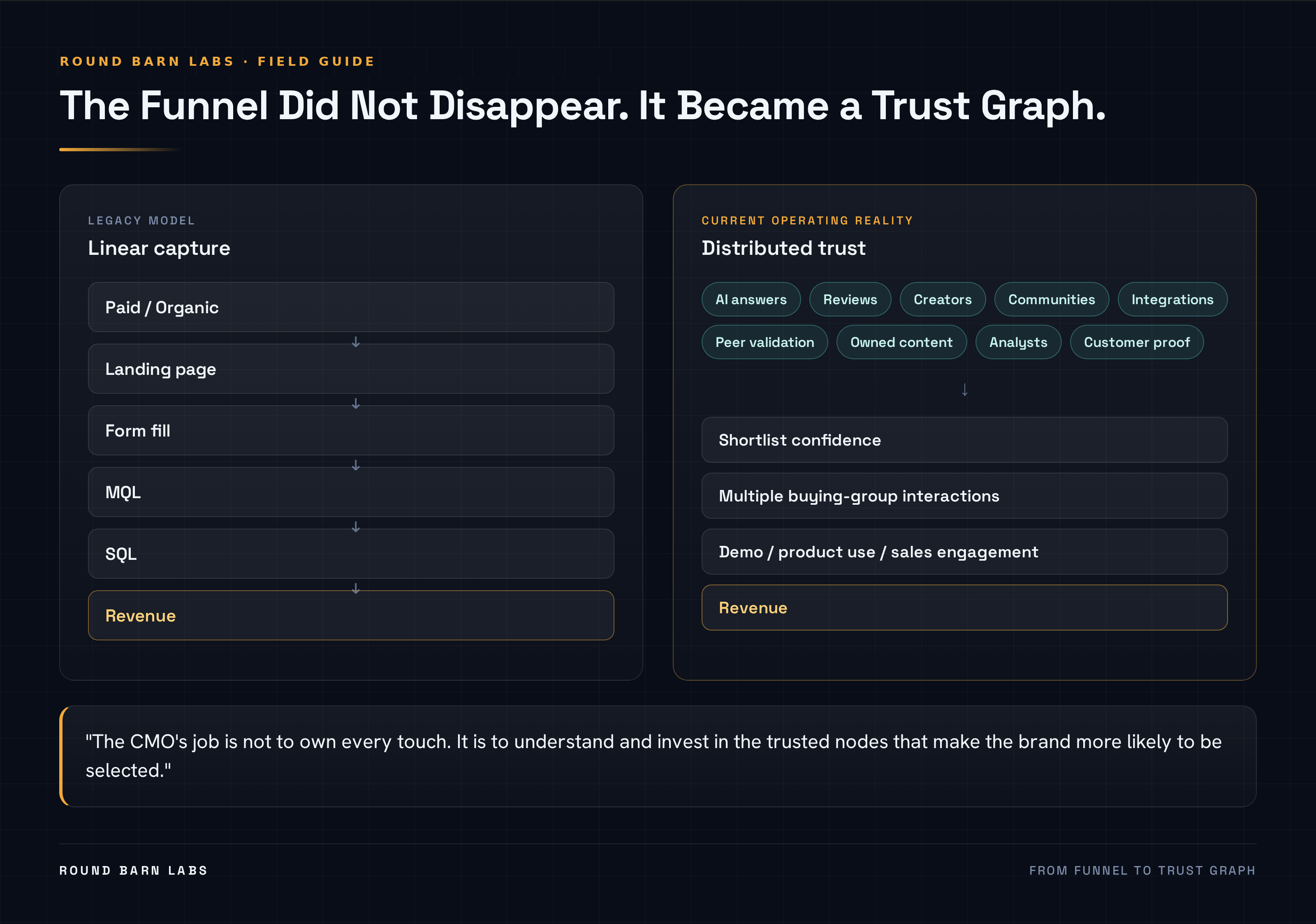
The CMO's job is not to own every touch. It is to understand and invest in the trusted nodes that make the brand more likely to be selected.
This is why “SEO versus partner marketing” is the wrong debate. Clear owned content makes the brand understandable. Independent sources validate it. Partners distribute it into relevant communities and workflows. Demand capture converts the resulting intent. Revenue measurement determines what deserves more funding.
3. The AI Discovery Influence Stack
The AI Discovery Influence Stack gives the CMO one operating model across teams that often work from separate dashboards. It connects what the market can understand, who validates the claims, who carries the message, how informed demand converts, and whether economic outcomes improve.
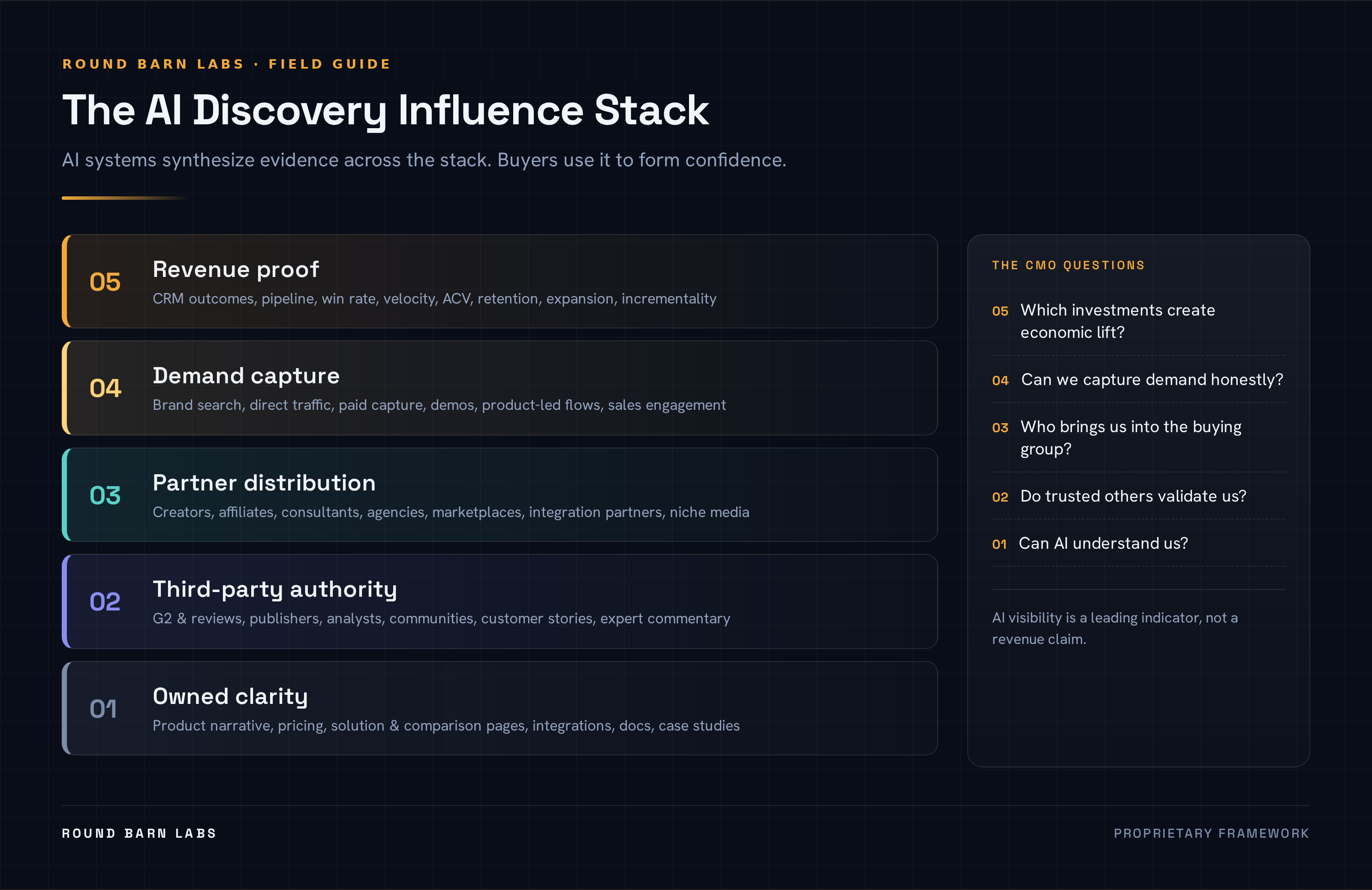
- Owned clarity: product narrative, pricing and packaging, solution pages, comparisons, integrations, documentation, case studies, and customer proof. Can AI systems and buyers accurately understand what we do, who we serve, and why we win?
- Third-party authority: reviews, publishers, analysts, communities, customers, and expert commentary. Do credible sources corroborate our claims without us controlling the narrative?
- Partner distribution: creators, affiliates, consultants, agencies, marketplaces, integration partners, and niche media. Who brings us into the buying group before it enters our tracked funnel?
- Demand capture: brand search, direct traffic, paid capture, demo flows, product-led motions, and sales engagement. Can we convert informed demand without assigning capture all the credit?
- Revenue proof: pipeline, win rate, velocity, ACV, retention, expansion, and incrementality. Which investments create meaningful economic lift?
AI visibility is a useful leading indicator of whether a brand is participating in category consideration. It is not a causal revenue metric. A brand can gain mentions without improving commercial outcomes. It can also influence revenue through partners, reviews, and communities without appearing in every AI answer.
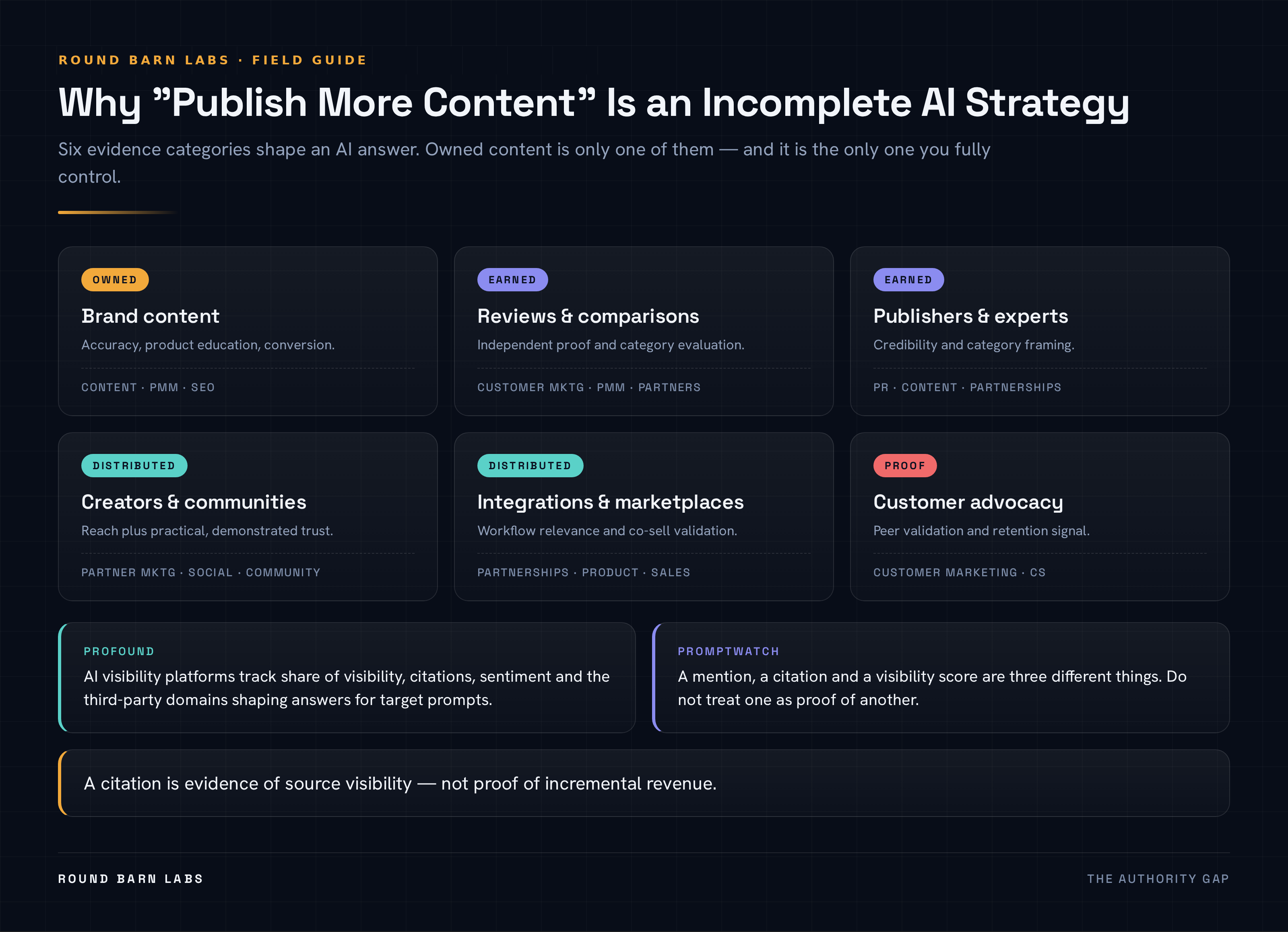
Tools such as Profound and PromptWatch can help teams observe prompt presence, mentions, citations, sentiment, cited domains, and competitive position. Those signals are valuable. They do not, by themselves, establish causality or ROI.
Measurement guardrail: a mention, a citation, and visibility are not the same thing. A mention is brand appearance. A citation is a sourced reference or link. Visibility adds context such as position, tone, competitive presence, and the prompts where the brand does not appear. None alone proves incremental revenue.
4. Four metrics. Four different questions.
The AI era does not require one magical source of truth. It requires triangulation: distinct methods assigned to the questions they are equipped to answer.
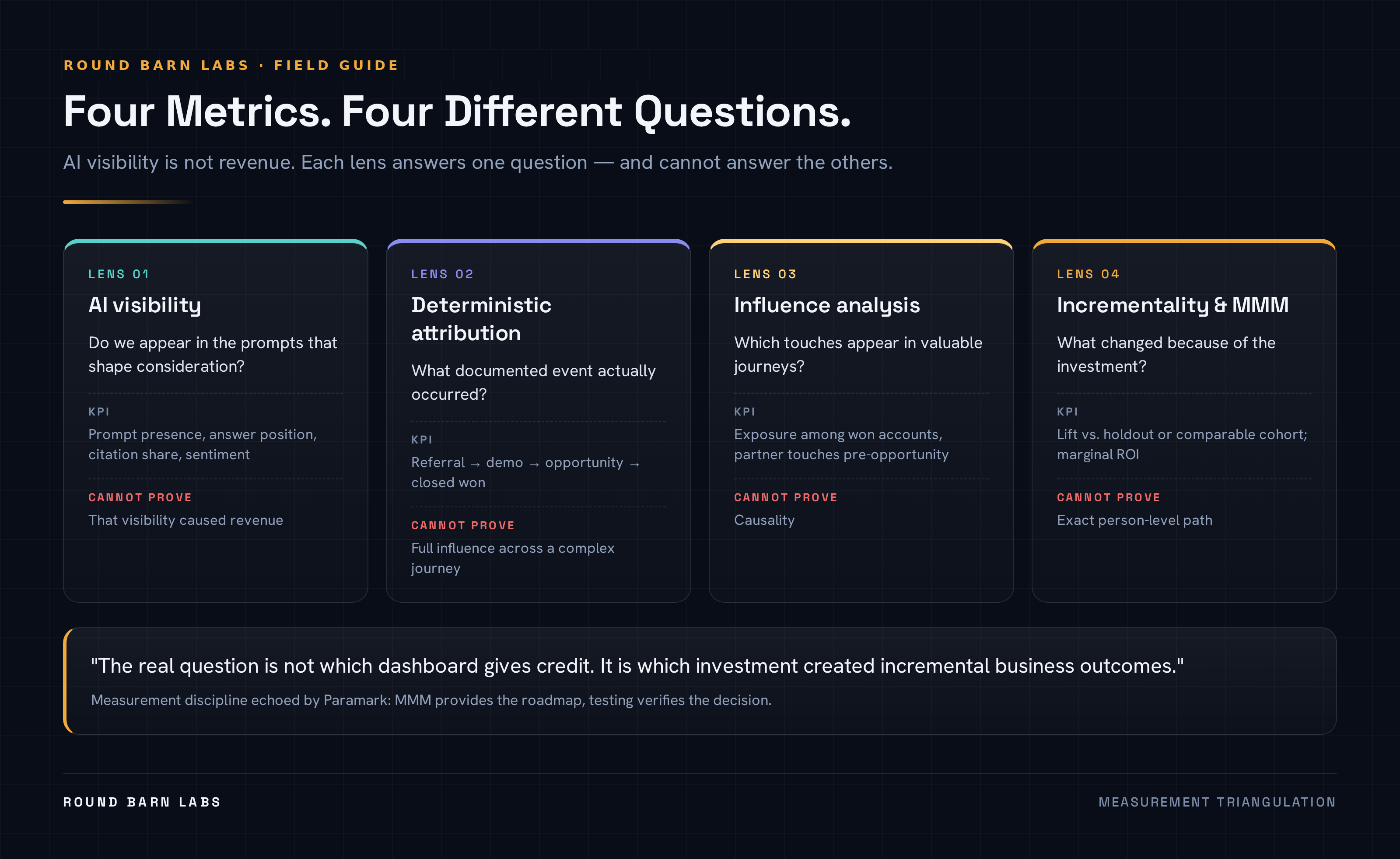
- AI visibility: do we appear in the prompts that shape consideration? Track priority-prompt presence, answer position, source mix, citation share, message accuracy, sentiment, and competitive context. This diagnoses discoverability — not revenue causality.
- Deterministic attribution: what documented event occurred? A tracked referral that becomes a demo, opportunity, and closed-won customer is valuable operational evidence. It does not reveal every influence across a complex journey.
- Influence analysis: which touches appear in valuable buying journeys? Examine partner interactions, review-site activity, events, content exposure, and integration engagement among high-quality opportunities. Correlation can identify patterns worth testing; it is not causality.
- Incrementality and MMM: what changed because we invested? Use holdouts, comparable cohorts, regional tests, pre/post designs, and marketing mix modeling to estimate lift and marginal return.
The real question is not which dashboard gives credit. It is which investment created incremental business outcomes.
Last-click attribution still has a job: it records a known conversion path and helps operate a channel. Its failure begins when a team treats it as proof of causality — or as the complete history of why a buying group trusted one SaaS vendor over another.
Use last-touch data to run the business. Use influence analysis to investigate meaningful buying journeys. Use controlled experiments and MMM to decide where marginal budget should go.
5. Give the CMO a scorecard built for the real journey
A useful monthly scorecard should move from leading indicators to diagnostic evidence to business outcomes. It should not flatten all eight metrics into one synthetic score, and it should never present directional gauges as financial proof.
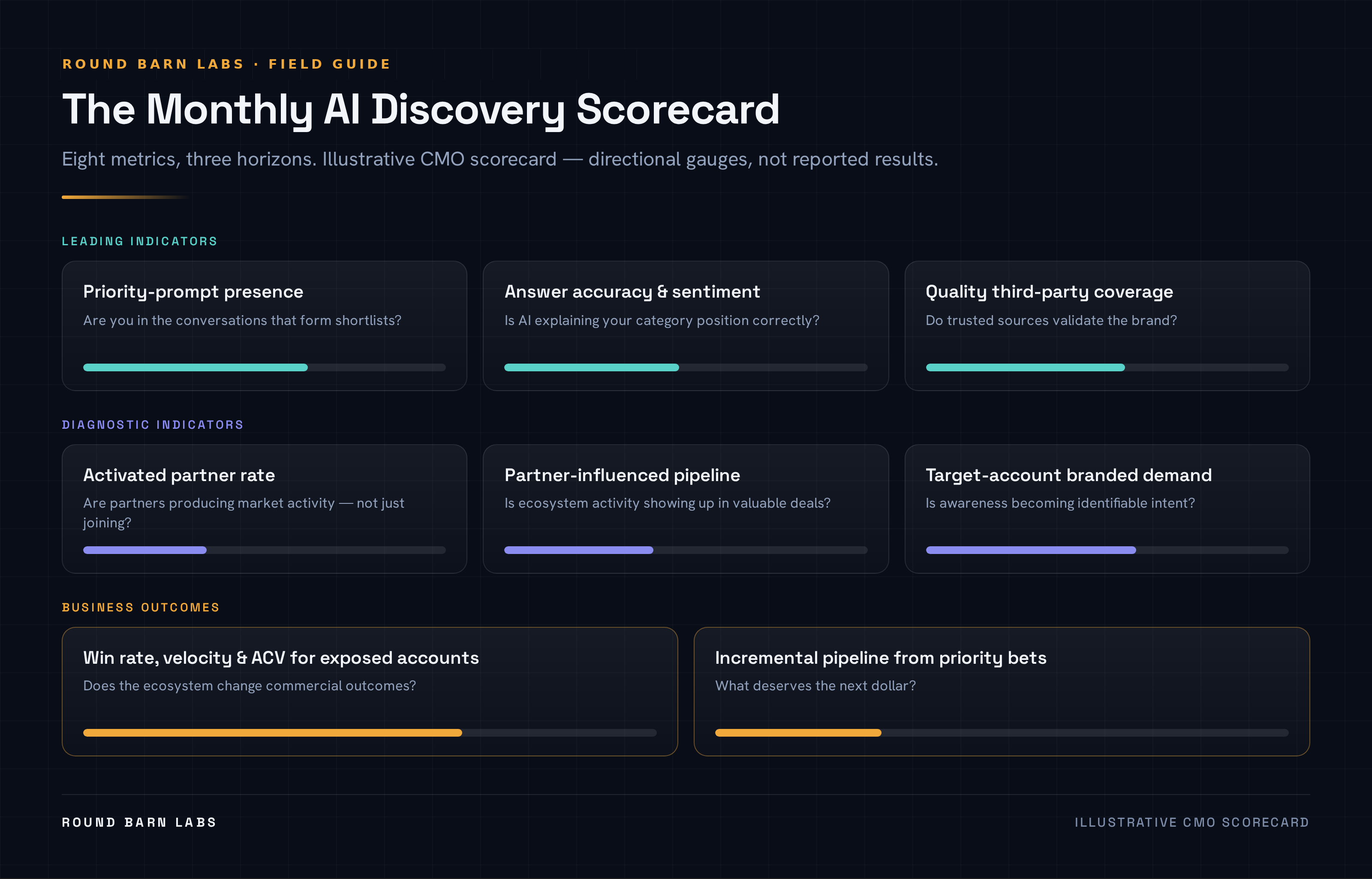
Track priority-prompt presence and answer accuracy. Audit the quality of third-party source coverage. Measure partner activation — not simply signed-partner count — and partner-influenced pipeline. Watch target-account branded demand. Then compare win rate, velocity, ACV, retention, and incremental pipeline for exposed cohorts.
The operating rhythm: read the scorecard from left to right. Visibility identifies where consideration may be forming. Authority and partner activity diagnose why. Capture shows whether interest becomes intent. Revenue and causal tests determine whether to scale.
6. Treat partner investment as authority investment
A partner should not be judged only by affiliate conversions. Evaluate the role each partner can play: reaching the ICP, creating independent education, earning rankings or citations, influencing buying committees, adding implementation credibility, and generating both attributable demand and untracked authority.
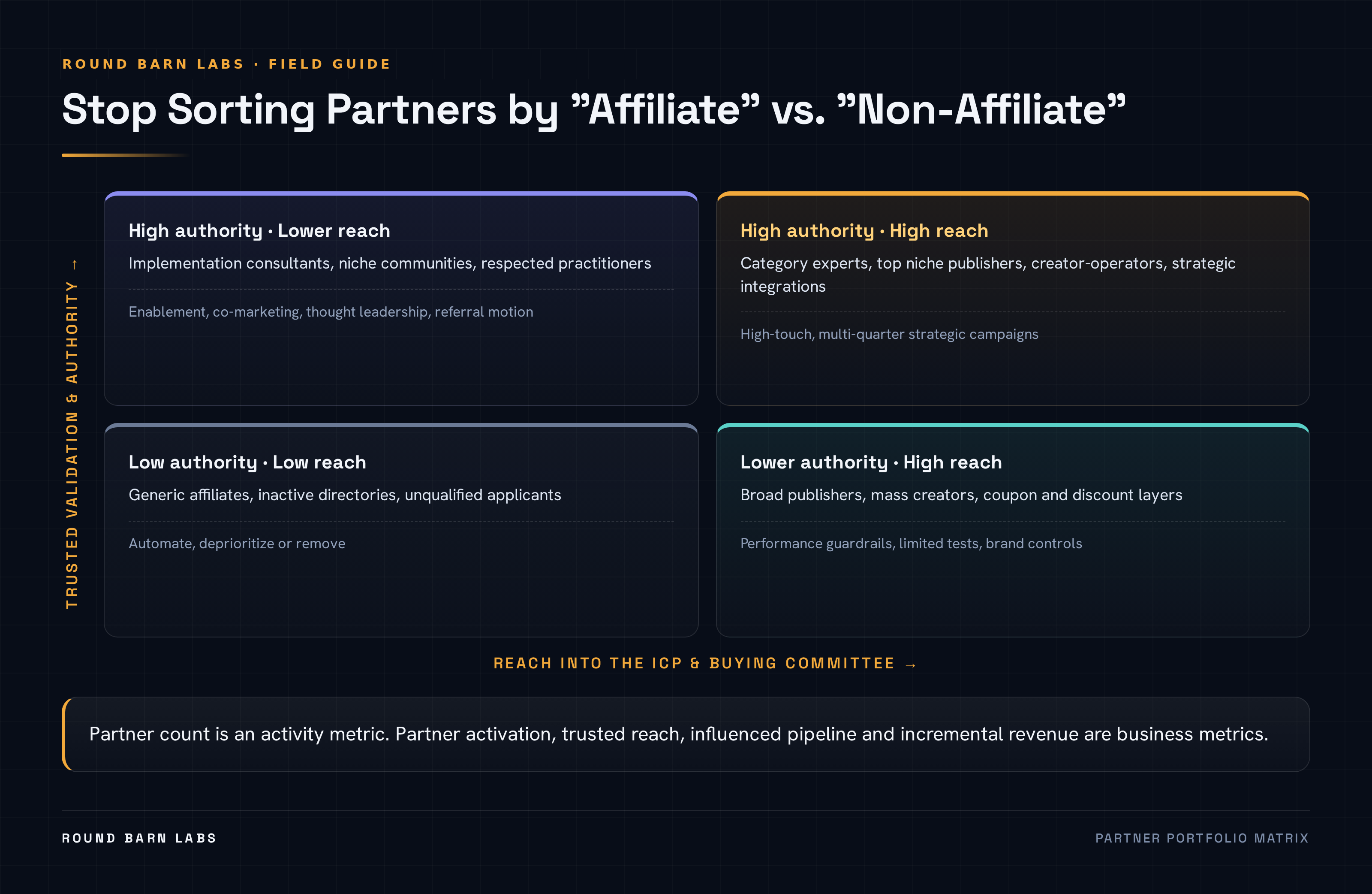
High-reach, high-authority partners warrant strategic, multi-quarter campaigns. Niche consultants and respected practitioners may bring exceptional trust even at lower scale. Broad publishers can be useful under performance guardrails. Generic affiliates and inactive directories should be automated, deprioritized, or removed.
Partner count is an activity metric. Partner activation, trusted reach, influenced pipeline, and incremental revenue are business metrics.
This requires executive sponsorship, alignment with revenue targets, multi-touch measurement, a clear testing budget, authentic partner voice, and sustained campaigns — not merely a partner application flow.
7. Do not reorganize around AI. Run a 90-day test.
Start by reserving 5–10% of an existing content, partner, or demand-generation budget for a deliberate learning cycle. Document the hypothesis before activation, define both leading and decision metrics, and agree on scale/stop criteria.
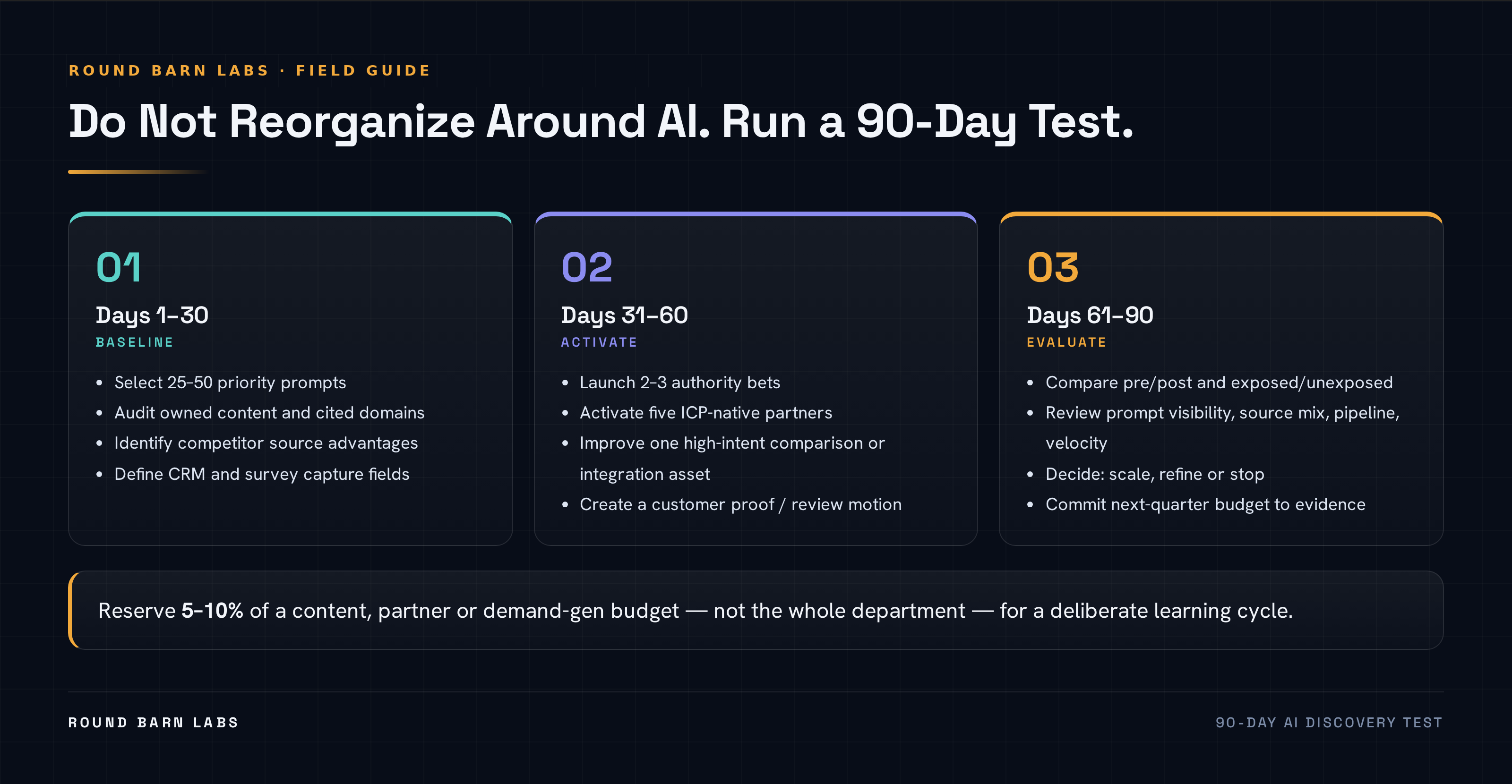
- Days 1–30 · Baseline: select 25–50 priority prompts. Audit owned content and cited domains. Identify where competitors enjoy a source advantage. Define CRM fields, survey capture, exposure rules, and the economic metrics that will determine success.
- Days 31–60 · Activate: launch two or three authority bets. Activate five ICP-native partners around one buyer question. Improve one high-intent comparison or integration asset. Strengthen customer proof and review coverage.
- Days 61–90 · Evaluate: compare pre/post and exposed/unexposed results. Review prompt visibility, source mix, target-account demand, pipeline, conversion, and velocity. Decide whether to scale, refine, or stop.
Examples might include sponsoring a high-credibility operator newsletter, building a definitive integration resource with a technology partner, activating expert creators around one buyer problem, or improving review-site presence in a high-intent category.
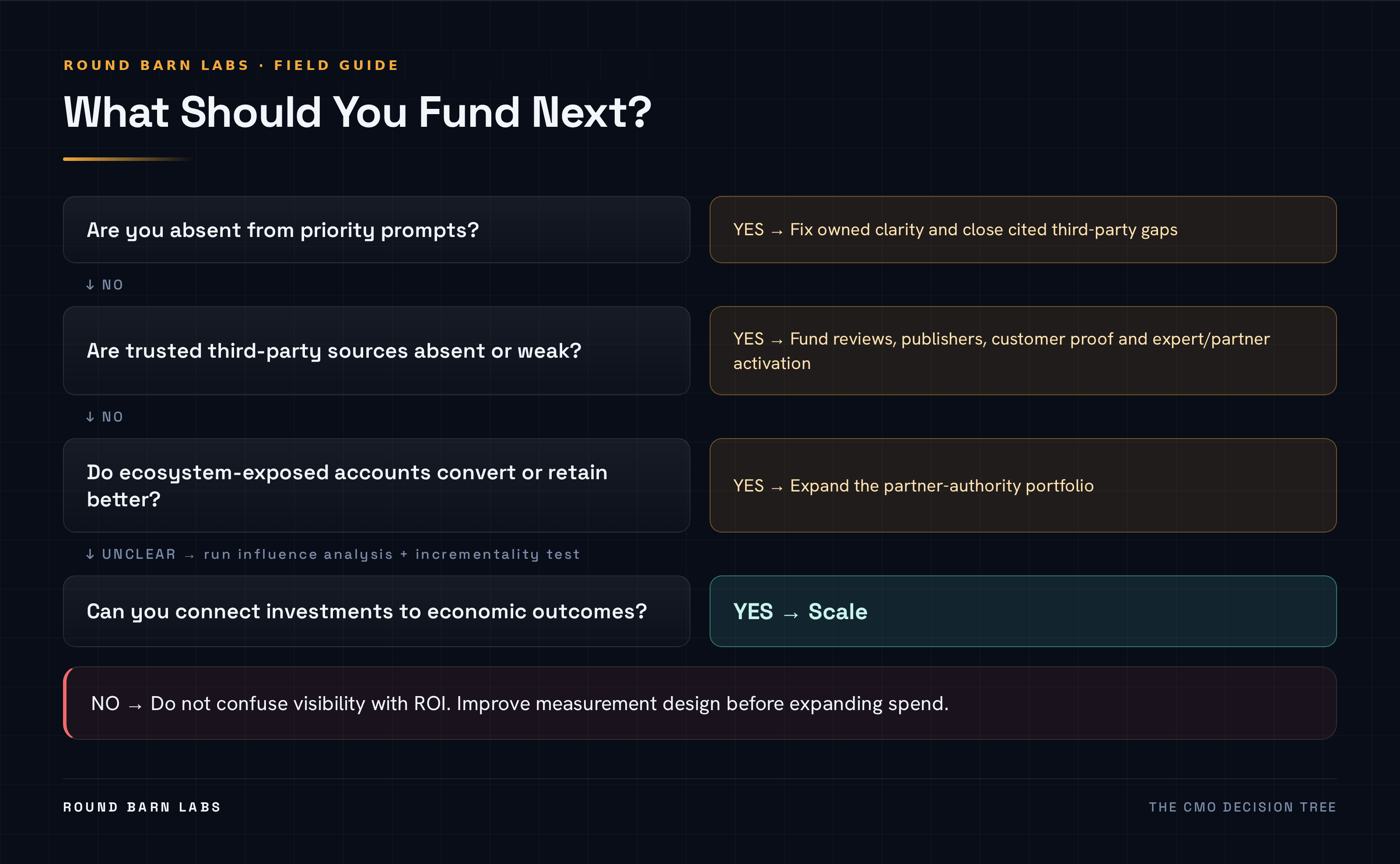
8. What should you fund next?
The decision should follow the bottleneck. If AI systems cannot understand the company, fix owned clarity. If trusted corroboration is weak, invest in reviews, customer evidence, publishers, experts, and partners. If exposed accounts appear stronger, test whether the relationship is incremental. If economic evidence remains unclear, improve the measurement design before scaling spend.
The assignment: run one cross-functional working session. Bring content, SEO, PR, partnerships, demand generation, RevOps, and customer marketing together. Map the 25–50 buyer prompts that matter, the sources shaping those answers, the partners already carrying authority, the fields your CRM can capture, and one test the team can complete in 90 days.
The executive conclusion
The click did not vanish entirely. It simply stopped carrying the full story. SaaS buyers now form confidence across a distributed system of AI answers, reviews, practitioners, partners, communities, product evidence, and peer validation before a known conversion appears.
The strongest CMOs will not chase citations as an end in themselves, nor discard attribution because it is incomplete. They will build an operating system that connects owned clarity, third-party authority, partner distribution, honest demand capture, CRM evidence, and incrementality.
AI visibility tells you whether you are participating in consideration. Revenue proof tells you whether the investment deserves the next dollar.
If your dashboard says “direct” but your buyers are being educated elsewhere, use the CMO scorecard above — the eight-metric monthly view that runs from AI visibility through third-party authority and partner activation to pipeline and incremental revenue — to find the sources of influence you are currently underfunding.
Request a Partner-Led Growth AuditSource and methodology notes
- G2 Software Buyer Behavior Report — buyer use of AI chatbots and review sites when building shortlists.
- Profound — product materials on share of visibility, citations, sentiment, and source-domain analysis.
- PromptWatch — product language distinguishing mentions, citations, and visibility.
- Paramark — materials on marketing mix modeling and incrementality testing.
- eMarketer — research on marketer confidence in measuring AI-influenced discovery.
- The AI Discovery Influence Stack, CMO scorecard, partner matrix, and decision framework are Round Barn Labs operating frameworks. They are not presented as independent market research.